









Screpy - AI SEO Audit Tool

Website Audit Tool for Technical SEO

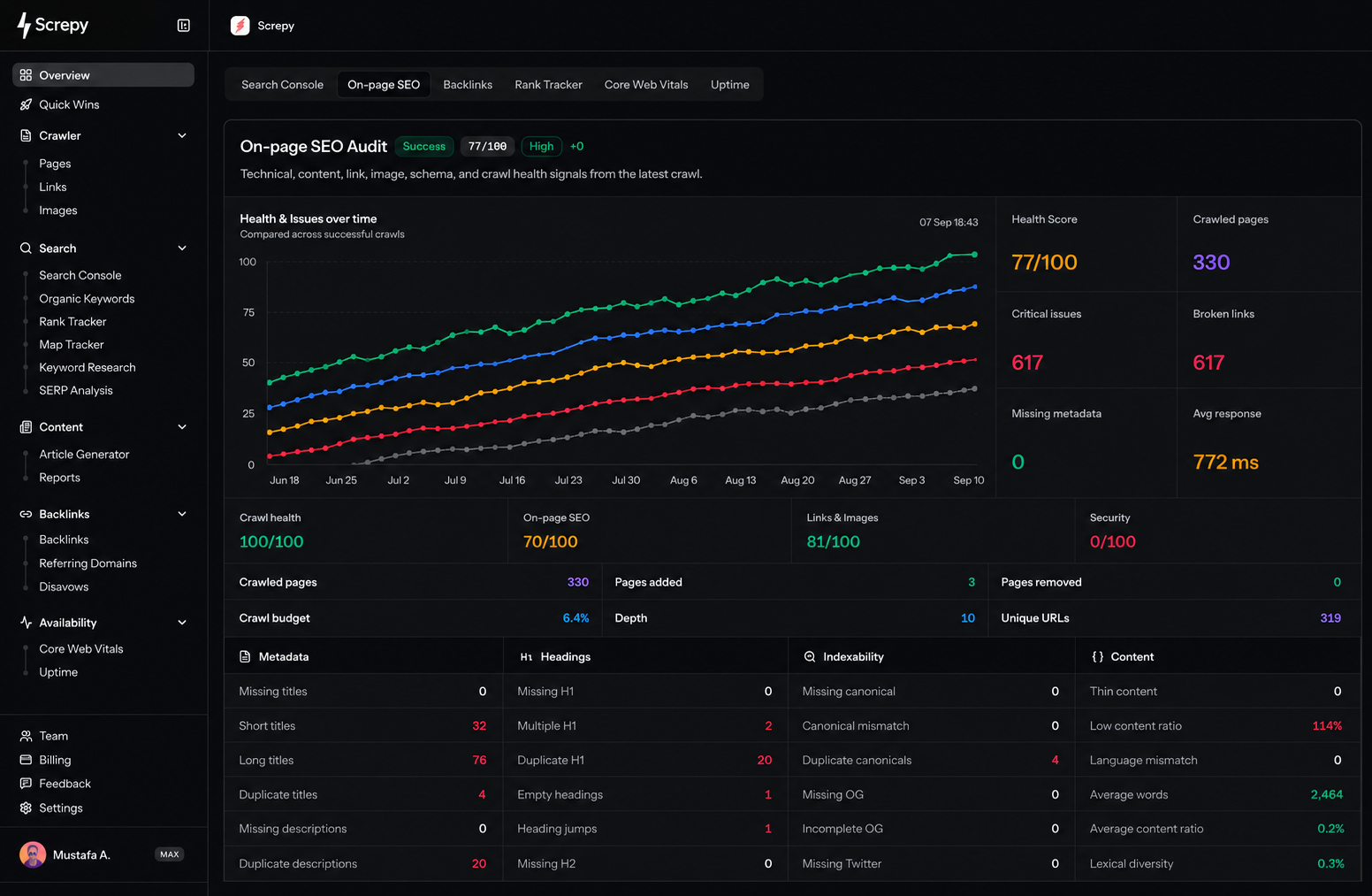
Turn a full-site crawl into a page inventory, grouped findings, and a practical fix queue. Review crawlability, status codes, redirects, canonicals, metadata, headings, links, images, response time, structured data, and security signals—then recrawl to verify what changed.

Screpy website audit dashboard showing site-wide SEO health, crawled pages, critical issues, broken links, metadata, headings, and indexability

TL;DR

Too Long; Didn't Read

Show summary

What does a full website audit cover?

Screpy Website Audit turns a completed crawl into Pages, Links, and Images inventories. Teams can investigate one URL, identify a repeated template or site-wide pattern, prioritize the underlying fix, export an implementation queue, and verify the public result in a later crawl.

Crawlability and indexation

  • Review status codes, redirects, final destinations, canonicals, crawl depth, and page accessibility.
  • Compare crawl scope, JavaScript mode, URL capacity, and access rules before interpreting coverage.

On-page and content signals

  • Compare titles, descriptions, headings, content signals, language, structured data, and social tags.
  • Separate isolated editorial findings from repeated CMS, template, route, or component problems.

Links, images, and experience

  • Trace link destinations to their source pages, anchors, attributes, status, and usage count.
  • Review image response health, accessibility, dimensions, responsive delivery, and page usage.

Monitoring and reporting

  • Create a dated baseline before launches, migrations, redesigns, and template changes.
  • Export filtered findings and recrawl after deployment to confirm the intended result.
Uber logo in Screpy SEO platform customer trust section
Philips logo in Screpy SEO platform customer trust section
FedEx Express logo in Screpy SEO platform customer trust section
Bosch logo in Screpy SEO platform customer trust section
Champion logo in Screpy SEO platform customer trust section
Iconfinder logo in Screpy SEO platform customer trust section
T-Mobile logo in Screpy SEO platform customer trust section
Carrefour logo in Screpy SEO platform customer trust section
Stanley logo in Screpy SEO platform customer trust section
Skoda logo in Screpy SEO platform customer trust section

Everything a full website audit should help you investigate.

Screpy keeps page, link, image, crawl, and search context connected. Each filter starts an investigation; the affected URL and its real purpose determine whether a change is needed.

See which URLs Screpy reached and what each request returned before treating a page-level signal as an SEO problem.

  • 2xx, 3xx, 4xx, 5xx, and final destinations
  • Crawl depth, discovery paths, and response time
  • Robots, access, timeout, and rate-limit context
Review whether important pages present consistent indexing signals and whether preferred URLs remain accessible.

  • Indexability and robots directives
  • Missing or conflicting canonical targets
  • Sitemap and crawl coverage context

Find missing, duplicated, empty, short, long, or inconsistent page elements across individual URLs and shared templates.

  • Title and meta-description coverage
  • H1 and heading hierarchy findings
  • Template patterns across related pages

Content and page structure

Use page-purpose and template context to investigate content signals instead of trying to force every URL toward the same score.

  • Word count and content-ratio signals
  • Language and page-structure consistency
  • Social metadata and security headers

Map each destination to the pages that reference it so broken paths, redirects, anchors, and attributes become actionable fixes.

  • Destination status and final behavior
  • Anchor text, attributes, and usage count
  • Every crawled source page for the link

Inspect image files, markup, and page usage together before changing accessibility text, dimensions, formats, or delivery.

  • Response health, source type, and format
  • Alt text, dimensions, srcset, and sizes
  • Source pages and repeated component usage

Use crawl response time to find investigation candidates, then connect important URLs with dedicated page-speed and Core Web Vitals evidence.

  • Slow-response page filters
  • Page-level performance context
  • Separate crawl timing from real-user experience

Structured data and enhancements

Review markup and search-presentation signals on the pages where they apply without treating schema presence as a ranking guarantee.

  • Structured-data presence and validation context
  • Open Graph and social-preview metadata
  • Representative page and template review

Read every crawled URL in context.

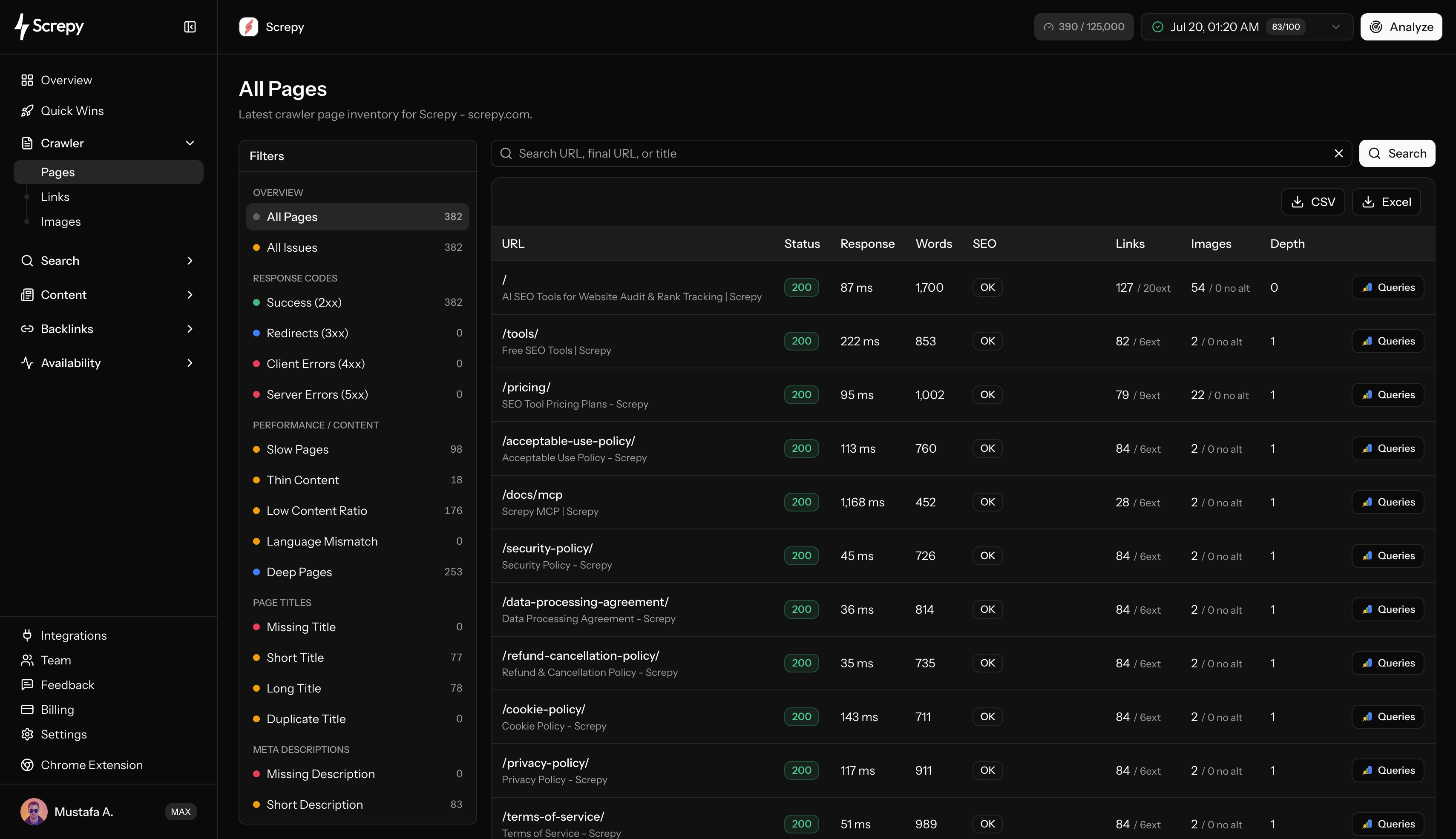
Turn a completed crawl into a URL-level inventory. Compare the response, destination, crawl depth, metadata, headings, canonical, content, structured data, social tags, image findings, and security signals for each page.

Learn more about pages report
  • Filter the full page inventory or focus on URLs with findings
  • Separate one-page defects from template-wide patterns
  • Export a filtered CSV or Excel implementation queue
Screpy Pages report showing crawled URLs and page-level technical SEO findings

Trace link problems back to their source pages.

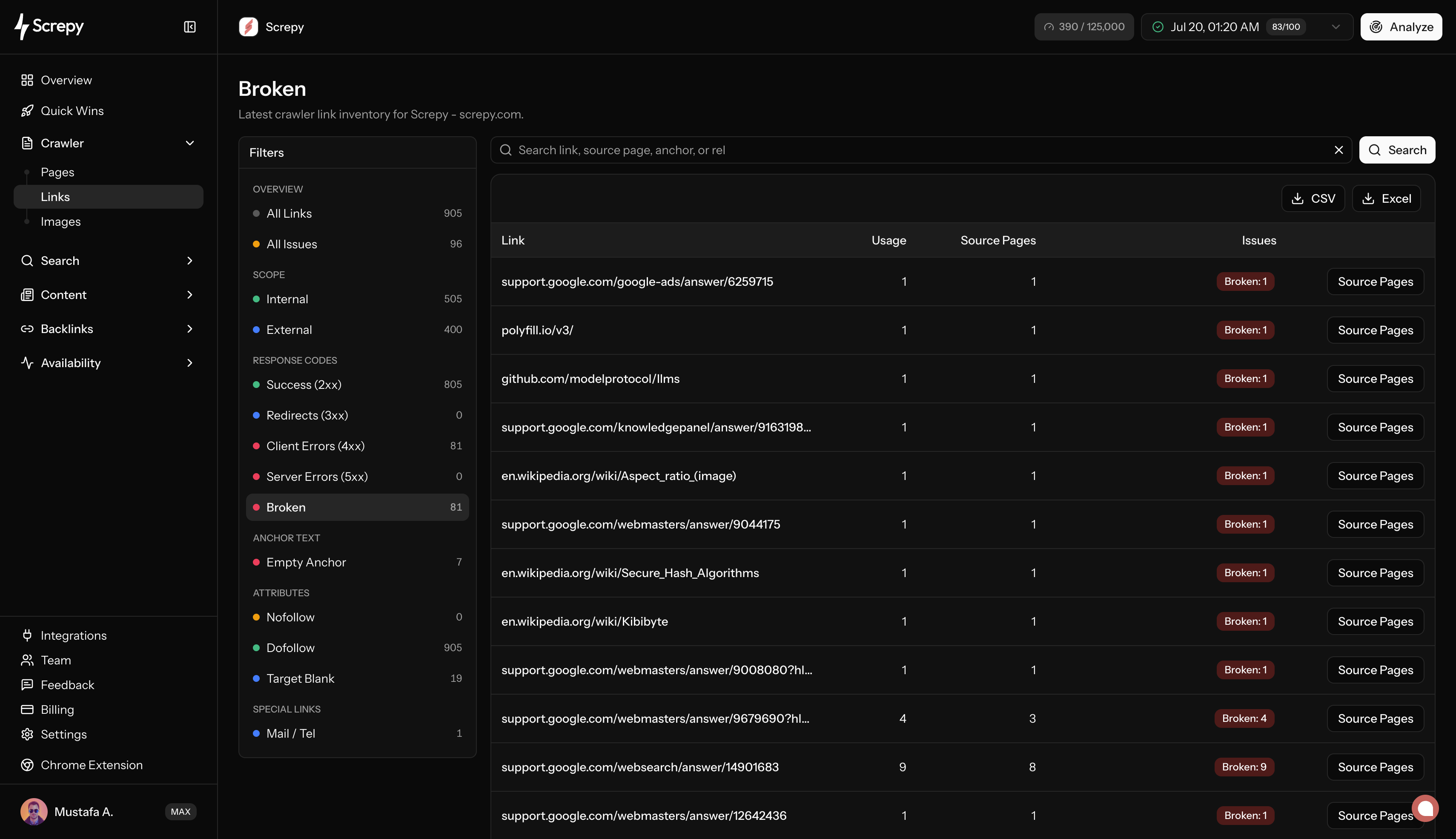
Review internal and external destinations with their response status, anchor text, attributes, usage count, and source pages. This turns a broken destination into a specific navigation, content, or shared-template fix.

Learn more about links report
  • Find broken and redirected destinations in one inventory
  • See every crawled page that contains the same link
  • Separate internal architecture from external references
Screpy Links report showing broken destinations and their source pages

Audit an image together with every page that uses it.

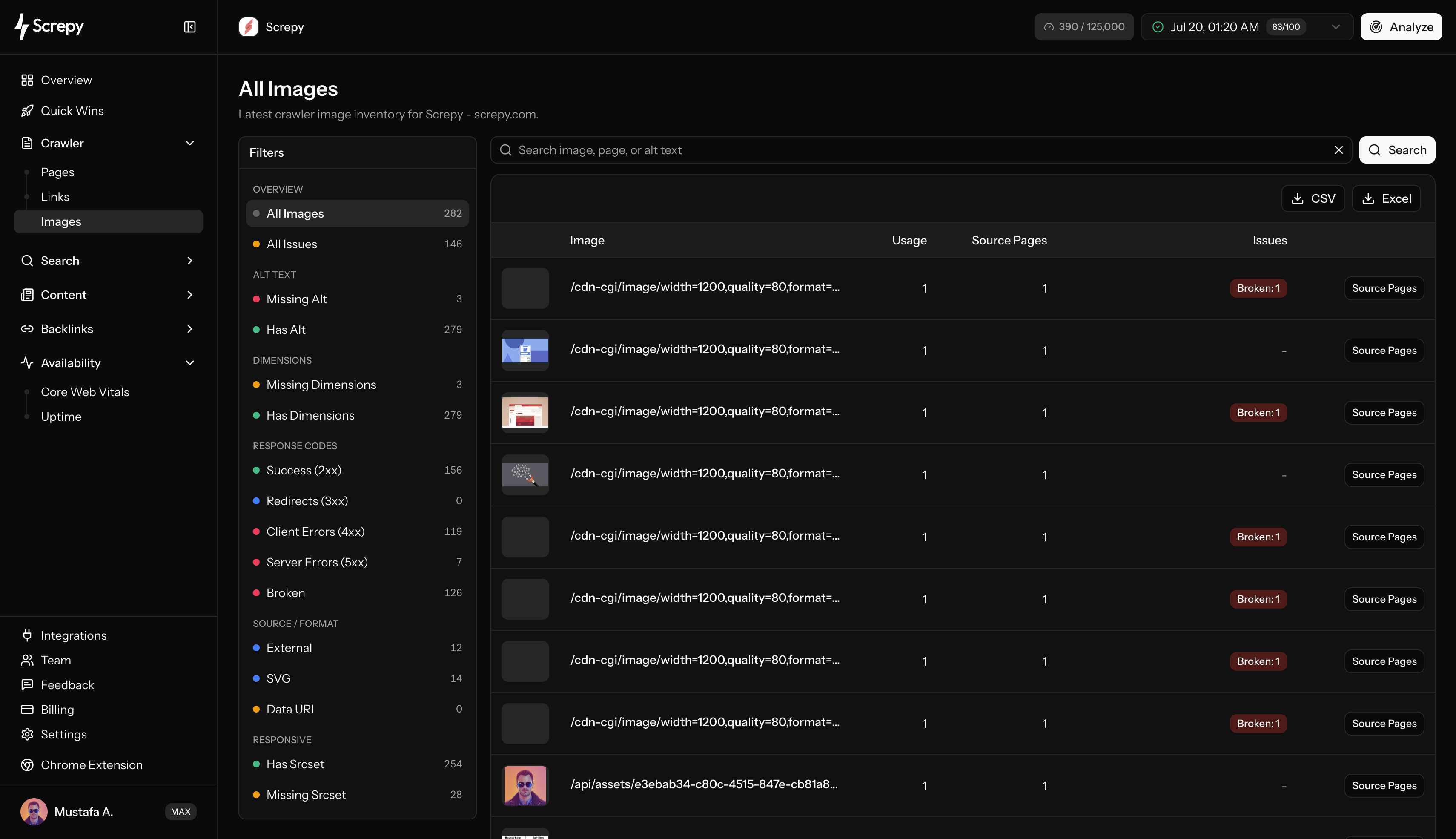
Group crawled image sources and inspect response health, alt text, dimensions, responsive delivery, loading behavior, source type, and page usage before changing an asset or shared component.

Learn more about images report
  • Distinguish one broken file from a repeated component issue
  • Review accessibility, layout, and delivery signals separately
  • Find the source pages and templates that need the fix
Screpy Images report showing image SEO, accessibility, and delivery findings

Compare evidence after the fix ships.

Treat every completed crawl as a dated snapshot. Keep the scope and settings comparable, review what changed across important templates, and confirm that the intended finding moved without hiding a new problem elsewhere.

Learn more about crawl progress
  • Record a baseline before a migration, release, or template change
  • Prioritize by page value, affected scale, confidence, and effort
  • Run a fresh crawl to verify the public result
Screpy website audit dashboard showing crawl health and issue progress

Turn crawl evidence into a verified fix.

A useful audit does not end with an issue count. Keep the crawl comparable, validate representative URLs, find the shared cause, and define what the next crawl should show.

  1. 01

    Create a comparable crawl baseline

    Confirm the starting URL, maximum URLs, crawl depth, JavaScript mode, access rules, and site version. The completed crawl becomes a dated snapshot—not a continuously changing view of the live site.

  2. 02

    Investigate representative URLs

    Open one affected URL and verify its response, rendered output, purpose, indexability, template, and business value before deciding that a filter represents a defect.

  3. 03

    Group the root cause and owner

    Separate an isolated editorial problem from a CMS content type, shared component, navigation rule, route, or site-wide configuration issue. Fix the pattern instead of editing every row independently.

  4. 04

    Publish, recrawl, and verify

    Inspect the public change, run another crawl with comparable settings, and confirm the affected percentage and URL pattern changed for the intended reason.

Run a website audit when the site changes—not only when traffic falls.

Technical regressions often begin with ordinary releases, content work, migrations, and shared-template edits. A crawl before and after the change gives the team evidence while the implementation context is still fresh.

Before and after a migration

Record redirects, canonicals, internal paths, important templates, and crawl coverage before launch, then compare the new site against the same baseline.

After a redesign or release

Check whether shared layouts, routing, metadata, images, scripts, or security changes introduced a repeated issue across valuable pages.

During ongoing content growth

Keep new articles, landing pages, categories, and programmatic templates connected, crawlable, internally linked, and technically consistent.

Use crawl evidence beside Search Console, release history, server logs, and rendered pages to investigate what changed without assuming one audit signal caused the traffic movement.

Choose a page check or a full-site audit

Use the free checker for one live URL. Use Website Audit when you need a crawl snapshot, repeated-pattern analysis, source-page context, exports, and verification across the site.

Screpy documentation

Learn how to run a website audit

Follow the Screpy guide to review audit results, investigate affected URLs, prioritize issues, and verify fixes after a new crawl.

Read the Website Audit guide

Website Audit FAQ

Understand crawl scope, JavaScript rendering, missing pages, issue counts, prioritization, comparison, reporting, and what a technical audit can—and cannot—prove.

What is the difference between a website audit and a single-page check?

A single-page check reviews one URL at a specific moment. A website audit crawls pages as one site, finds repeated patterns, compares URLs, and gives your team a site-wide workflow for prioritizing and monitoring fixes.

What does Screpy check in a website audit?

Screpy reviews crawl access, HTTP status codes, redirects, crawl depth, response time, metadata, headings, canonicals, content signals, structured data, social tags, security headers, internal and external links, images, and related technical findings across crawled pages.

Can Screpy find issues that repeat across many pages?

Yes. A site-wide crawl makes it easier to see when the same issue appears across templates, categories, or groups of URLs. This helps teams fix the underlying pattern instead of reviewing every page in isolation.

How often should I run a website audit?

Run a full audit after major site changes, migrations, redesigns, and content updates. For active websites, recurring audits are useful because new technical issues can appear after routine releases and edits.

Can Screpy audit websites that rely on JavaScript?

Screpy provides a JavaScript crawl setting for sites whose important links or content are created in the browser. JavaScript rendering does not bypass robots rules, authentication, bot protection, server errors, or the project crawl scope.

Why is an important page missing from the audit?

First check whether the URL returns usable HTML, allows ScrepyBot, is linked from a crawled page, falls within the selected depth and URL capacity, and avoids redirect loops, authentication, bot challenges, timeouts, or server errors.

Why can the issue count increase after I fix the website?

A newer crawl may discover more pages, reach a previously blocked template, or use different scope settings. Compare the crawled-page total, affected percentage, URL patterns, crawl configuration, and site version before deciding whether website health improved or declined.

How should I prioritize website audit issues?

Start with problems that affect crawling, indexing, availability, or many important pages. Then consider page value, affected templates, search traffic, conversion impact, and the effort required to fix the underlying cause.

Can I compare website audit results over time?

Yes. Treat completed crawls as dated snapshots and compare them with equivalent scope and settings. Review which findings were fixed, which remain, which are new, and whether the same page types and important URLs were included in both crawls.

Can I share website audit results with my team or clients?

Yes. Screpy supports reports and exports so audit findings, completed work, and remaining issues are easier to communicate with teammates, clients, developers, and stakeholders.

Does fixing every website audit finding guarantee higher rankings?

No. A website audit helps you investigate technical condition and verify implementation changes, but it does not guarantee rankings or traffic. Search outcomes also depend on relevance, content quality, authority, competition, demand, indexing, and how search engines interpret each page.

SEO That Fits Your Budget

Explore how Screpy combines audits, rankings, AI visibility and monitoring, with clear plan limits.

Cheap SEO Tool