
Rank Tracker User Guide
Track keyword rankings and follow their progress over time.
Rank Tracker follows how selected keywords appear in Google over time. Use it for a deliberate set of business-relevant queries, not as a complete measure of SEO success. Rankings can move while traffic stays stable, and traffic can change because of demand even when ranking is stable.
Add keywords with a clear purpose
Select Add keywords, enter one keyword per line, and add up to 100 keywords at once. Set the device context (Mobile, Desktop, or Both), country, and language before saving. Keep these settings aligned with the audience you care about; similar keywords can produce different result pages across devices and markets.
Use Manage segments to organise the tracked set when you need to review a product line, location, or content cluster separately. The dashboard table can be exported as CSV or Excel.
Review the tracked result with the landing page. If the ranking page is not the page you intended, check topical overlap, internal linking, canonical behavior, and the page's ability to answer the query. Creating several near-duplicate pages is rarely the best fix.
Read movement over time
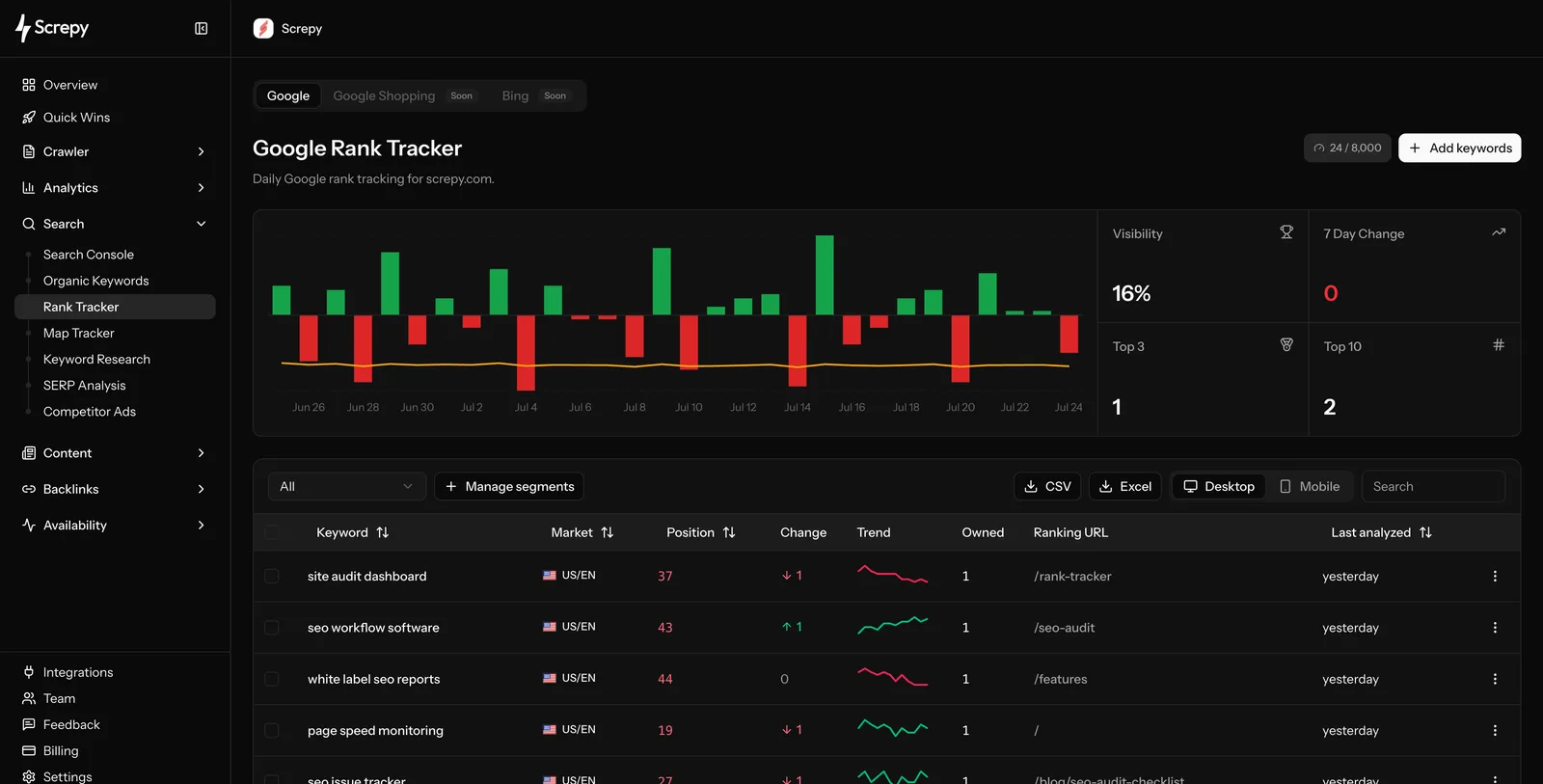
The overview reports visibility, seven-day change, Top 3, and Top 10 counts. Each table row shows the configured market, current position, change, trend, ownership signal, ranking URL, and last analysis time. Use a consistent time range and look for sustained movement rather than reacting to every daily change. Record relevant changes to content, technical implementation, competitors, or search features. This gives a later trend context that a single position number cannot provide.
Rank Tracker focuses on the first 10 Google results
Screpy limits Rank Tracker to the first 10 Google results because deeper result pages are not reliably accessible. Use Search Console and Organic Keywords for broader keyword visibility.
Use Rank Tracker through API or MCP
The Rank Tracker REST API exposes the overview, cursor-paginated keywords, stored analysis history and results, keyword management, and segment preview or management. Use numeric keyword, analysis, and segment IDs only with the project UID that returned them.
Screpy MCP provides the same core workflow through a smaller agent-focused toolset. A keyword detail request includes up to 30 history records and stored results from the selected or latest analysis; use the REST API when you need to paginate through the complete history. Keyword additions and destructive changes require confirmation.
API and MCP integrations do not provide CSV/XLSX export, live SERP lookup, or manual reanalysis. New keywords still start their normal first analysis, and existing keywords continue on the configured schedule.
Common questions
Why is my rank different from what I see in my browser?
Search results can vary by location, language, device, personalization, and time. Use the configured tracking context as the consistent comparison point.
Should I track every keyword variation?
No. Track representative, decision-relevant terms. Use Search Console and keyword research to discover broader query patterns.
Explore Screpy's search-visibility features for the broader workflow around rankings, maps, and content planning.
Read how Screpy measures search-visibility data before acting on a movement. Google also explains that its ranking systems use many page-level and site-level signals in its ranking systems guide.