

Topic clusters turn scattered pages into a connected content system built around one core subject. The structure usually includes a pillar page that explains the big topic, plus supporting articles that answer narrower questions, tied together with intentional internal linking based on search intent. Planning starts by picking a parent topic you can genuinely own, then mapping one clear target query and angle to each page so you cover the theme without keyword cannibalization. The non-obvious win is setting strict boundaries between subtopics early, because overlap, not lack of content, is what quietly stalls rankings.
When two planned cluster pages appear too similar, a typed workflow can classify blog-topic overlap with TypeSafe AI’s Jev before an editor decides whether to separate, merge, or retarget them.
What is a topic cluster in SEO, and how does it work?
Pillar pages vs cluster pages
A topic cluster is a way to organize content so your site covers one subject deeply, without publishing isolated articles that compete with each other. It typically has two page types:
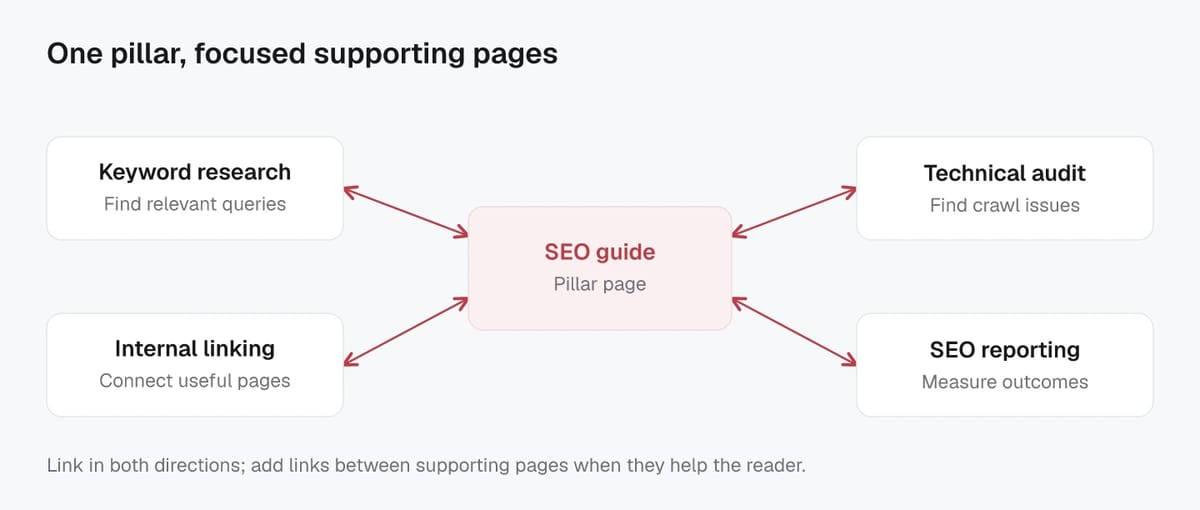
- Pillar page: The central, comprehensive page for the broad topic. It explains the “what,” “why,” and main subtopics at a high level, and helps users choose the next step.
- Cluster pages (supporting pages): Focused articles that answer one specific question or intent (for example: “how to do X,” “X templates,” “X vs Y,” or “best practices for X”).
The goal is clarity. Humans should immediately understand the content map, and search systems should be able to identify which page is the main authority and which pages provide depth.
Hub-and-spoke internal linking model
Most topic clusters follow a hub-and-spoke model:
- The pillar page links out to each supporting page.
- Each supporting page links back to the pillar page using descriptive, natural anchor text.
- Supporting pages may also cross-link to each other when it genuinely helps the reader.
This internal linking makes discovery easier, reduces orphan pages, and reinforces topical relationships. It also helps search engines interpret meaning from your internal anchors, which is why Google emphasizes keeping internal links crawlable and using relevant anchor text in its link best practices.
Topic clusters vs categories and tags
Categories and tags are mainly site organization and navigation tools. They group content, but they often lack:
- A single “best” page for the topic (the pillar).
- A deliberate intent map (one intent per page).
- Consistent, editorially controlled internal linking.
A topic cluster is more strategic. It’s built to rank, convert, and support AI-driven search experiences by making your topical coverage and page relationships explicit.
Why topic clusters improve rankings, topical authority, and user experience
Better crawl paths and relevance signals
Topic clusters create cleaner paths for both crawlers and humans. When your pillar page and supporting pages link to each other in a predictable way, it becomes easier for search engines to discover related URLs, understand which page is the “main” one, and interpret how subtopics connect.
Just as important, a well-linked cluster reduces orphan pages and makes your internal anchors more meaningful. Instead of dozens of random “read more” links, you’re consistently signaling what each page is about and where it fits. That clarity supports modern search systems that rely on multiple signals, not just keywords, to assess relevance and site quality, including the expectations laid out in Google’s Search Essentials.
Coverage depth and intent matching
Clusters work because they force you to plan coverage around real search intent, not just a list of keywords. A strong cluster typically includes supporting pages that match different intents, such as:
- A “how to” page (task completion)
- A “best tools” or “examples” page (evaluation)
- A “vs” page (comparison)
- A troubleshooting page (problem solving)
When each page targets one clear intent, you cover the topic more completely while avoiding overlap that confuses users and triggers keyword cannibalization. Readers also get a better experience because they can move from a broad overview to the exact next question they have, without bouncing back to search.
Consolidating authority with internal links
Internal links help concentrate attention and authority within a cluster. Practically, that means your most link-worthy supporting pages can pass value back to the pillar, and the pillar can distribute visibility to newer or less-discovered pages.
In an AI-influenced search world, consolidation matters even more. AI-driven results tend to reward content that is easy to interpret, cite, and connect. A topic cluster gives your site a clear “map” of definitions, subtopics, and relationships, which reduces ambiguity and makes it easier for both people and systems to trust which page should be treated as the primary reference.
Cluster-worthy topic selection and defining the right scope
Start with the broader topical-authority planning workflow before drawing new cluster pages. Check existing posts and competitor content gaps to decide whether the reader needs a new URL, an update to a current page, or no additional page at all.
Business fit and conversion alignment
The best topic cluster is one you can win on expertise and monetize without forcing it. Start with a parent topic that matches your product, service, or core audience problem. Then define what a “conversion” means for that cluster. It could be a demo request, free trial, email signup, template download, or moving a reader to a comparison page.
A practical test: if someone lands on the pillar page and reads for two minutes, can you offer a next step that feels helpful and natural? If not, the topic may be interesting, but it is not a strong growth lever.
In an AI-driven search landscape, business fit also means “citation fit.” Clusters built around clear definitions, repeatable processes, and trustworthy examples are more likely to be used as grounding in AI answers than vague thought-leadership.
When not to build a cluster
Skip a cluster when the scope is too broad to cover with real depth, or when you cannot add anything distinct beyond what already exists. Also avoid clusters that will push you toward thin, repetitive pages. That pattern can backfire, especially if content is created primarily to game rankings instead of helping users, which conflicts with Google’s people-first content guidance.
Another red flag is building pages around slightly reworded keywords with the same intent. That usually leads to cannibalization and confused internal linking.
MVP cluster size vs mature cluster coverage
An MVP cluster should be small but complete. In practice, that is often one pillar page plus 4 to 8 supporting pages that cover the main intents (how-to, definitions, comparisons, troubleshooting, and best practices). Publish the core set, interlink it, and make sure each page has a clear job.
A mature cluster grows from performance data. Expand into edge-case questions, industry variants, and deeper “next-step” guides. As AI search evolves, prioritize pages that are easy to extract and cite, with strong structure, precise terminology, and clear attribution of claims, aligning with guidance like Bing’s Webmaster webmaster guidelines.
Keyword and subtopic research that maps to real pages
Subtopic discovery from SERPs and competitors
Good topic cluster planning starts in the SERP, because the SERP tells you what Google believes the query means. For your pillar keyword, scan page 1 and list the recurring subtopics in titles, headings, and featured sections like People Also Ask, featured snippets, video results, and forums.
In 2026, you also want to note when queries trigger AI Overviews, because those SERPs often reward pages that give clear definitions, tight step-by-step guidance, and easy-to-cite explanations. If AI Overviews appear for your topic, include subtopics that answer “why,” “how,” and “what to do next,” not just “what is it.”
Competitor research is about gaps, not copying. Look for:
- Questions competitors mention but do not fully answer
- Subtopics buried in one giant post that could be a dedicated supporting page
- Repeated examples, templates, or checklists that signal strong demand
One search intent per page
A clean cluster requires a simple rule: each page has one primary intent. If a keyword set contains mixed intent (definition + tool list + tutorial), split it into separate pages and connect them with internal links.
Match the page format to the intent:
- “What is…”: definition, context, quick examples
- “How to…”: steps, pitfalls, checklist
- “Best…”: criteria, comparisons, update date, who it’s for
This is also AI-friendly. Pages with a clear intent are easier for systems to summarize and for readers to trust.
Keyword-to-page mapping to avoid cannibalization
Before you write, build a keyword-to-page map that assigns:
- One primary keyword (or tight cluster) to one URL
- A clear angle (beginner, advanced, template, comparison)
- 3 to 8 secondary variations that support the same intent
If two planned pages would answer the same question, merge them or redefine the angle. After publishing, revisit the map quarterly and consolidate overlapping pages with updates and redirects when needed.
Pillar page outline and supporting page plan that prevents overlap
Pillar page coverage boundaries
A pillar page should feel complete, but it should not try to rank for every long-tail query in the cluster. Set boundaries up front by deciding what the pillar will do:
- Define the topic and key terms in plain language.
- Explain the main framework or process at a high level.
- Summarize each major subtopic in short sections (often 150 to 300 words each).
- Point readers to the best supporting page when they need depth, examples, steps, templates, or comparisons.
A simple rule that prevents overlap: if a section needs more than a screenful of detail to be truly helpful, it probably deserves its own cluster page.
Supporting page angles and intent targets
Supporting pages should be intentionally different from each other, even when keywords look similar. Choose angles that map to distinct intents, such as:
- Beginner “how-to” (first-time implementation)
- Advanced guide (edge cases, scaling, workflows)
- “X vs Y” comparison (decision support)
- Checklist or template (downloadable, actionable)
- Troubleshooting (common mistakes and fixes)
For AI-influenced search, also plan at least one page that answers the “why” behind the process. Those pages often get referenced because they provide reasoning, not just steps.
Lightweight content brief for each cluster page
A brief does not need to be long to be useful. What matters is that every writer, editor, or stakeholder can see how the page is different from the pillar and from neighboring pages.
Must-have fields: intent, angle, links, CTA
Include these fields for each cluster page:
- Intent: What problem is the reader trying to solve?
- Angle: What makes this page distinct (audience, use case, depth level)?
- Primary keyword: One main query the page is built around.
- Secondary terms: Variations that match the same intent (not new intents).
- Internal links: Link to the pillar and 1 to 3 relevant cluster pages (with suggested anchor text).
- CTA: One next step that fits the intent (tool, demo, signup, related guide).
- Not covering: A short “do not include” note to avoid cannibalization.
Internal linking structure that connects the cluster correctly
Link rules between pillar and supporting pages
A topic cluster works only if the internal links are consistent and intentional. At minimum, make it bi-directional: the pillar page should link to every supporting page, and every supporting page should link back to the pillar.
Beyond that baseline, keep a few rules strict:
- Use crawlable HTML links (standard
<a href>), not links hidden behind scripts or blocked UI patterns. - Link only when there’s a real next step. More links is not automatically better.
- Refresh older supporting pages to link to newer ones, so your cluster doesn’t rely only on the pillar for discovery.
- Avoid “orphan” cluster pages with no in-cluster links pointing to them.
Google’s guidance on internal link crawlability and anchor clarity is a good north star for this. Link best practices are especially relevant when you’re building clusters at scale.
Contextual anchors and placement guidance
Anchor text should describe what the reader will get on the destination page. In practice, that means short, specific anchors like “topic cluster internal linking checklist” instead of generic “learn more.”
Place your most important links:
- Near the first time you mention a subtopic (high visibility).
- Inside the main body copy (higher contextual relevance than footers).
- In sections that naturally answer “what should I read next?”
This also supports SEO for the AI world. AI systems and browsing agents do better when your pages have clear pathways and unambiguous labels for related concepts.
Navigation, breadcrumbs, and URL structure choices
Your cluster should match a simple site structure. Use a logical URL pattern (for example, /topic/ and /topic/subtopic/) and keep it stable for evergreen content.
Breadcrumbs and navigation menus should reinforce the same hierarchy users see in the content. Even when search results choose different snippet formats, clean navigation still improves usability and helps both crawlers and AI tools understand how your site is organized.
Measuring and maintaining topic clusters after publishing
Tracking KPIs by cluster, not by single pages
A topic cluster is a system, so measure it like one. Start by grouping the pillar and all supporting URLs, then track performance as a combined set. The most useful cluster-level KPIs usually include organic clicks and impressions, branded vs non-branded growth, conversions attributed to organic sessions, and how often the pillar is the top landing page versus supporting pages.
In 2026, add AI visibility to your baseline. Google Search Console now includes a dedicated generative AI performance report that shows how your site appears in generative AI features, so you can track impression trends alongside classic organic results. That helps you spot clusters that are getting “seen” in AI answers even when click patterns change. Generative AI performance report.
Retrofitting clusters onto existing content
Retrofitting is usually faster than starting from scratch. Begin with an inventory of existing posts on the topic and pick the best candidate to become the pillar (often the most comprehensive and most-linked page). Then:
- Merge or rewrite overlapping pages so each URL has one clear intent.
- Redirect retired URLs to the most relevant page, or use canonicalization when consolidation is not possible.
- Add pillar-to-supporting links and supporting-to-pillar links, then update older posts to connect the whole cluster.
Done well, retrofits reduce cannibalization and make your internal linking more intentional without needing a full content rebuild.
Editorial governance to keep clusters up to date
Clusters decay when ownership is unclear. Assign a “cluster owner,” set a refresh cadence (often quarterly for competitive topics), and maintain a simple rulebook: naming conventions, internal link standards, and what qualifies as a new supporting page versus an update.
For AI-era SEO, governance should also include accuracy hygiene. Keep definitions consistent across the cluster, update examples when tools or SERPs change, and add clear “last updated” signals where appropriate. Over time, expect reporting to lean more on cluster-level outcomes, including AI visibility and assisted conversions, not just rankings for a single keyword.
Related Screpy guides
- How Does AI-Powered SEO Analytics Turn Search Data Into Actions?
- What Is an SEO Report Generator and How Does It Work?
- What SEO Alerts Should You Monitor Before Traffic Drops
Method and limitations
This guide is a practical review framework, not a controlled experiment or a guarantee of rankings. Record the tested URL, date, device or market, baseline output, exact change, and post-change result. Validate material recommendations against the current primary documentation and test risky changes on a staging site first.
Verification checklist
| Check | Evidence to record |
|---|---|
| Baseline | URL, date, device or market, and current metric or output |
| Change | Exact action, configuration, and environment |
| Outcome | Re-run the same check and compare the result and limitations |