


Before and after a release
Capture a baseline before a migration, redesign, navigation change, or shared-template release, then compare the next successful crawl using equivalent settings.
Turn the latest completed website crawl into a transparent 0–100 health score. Review the weighted crawlability, on-page content, links and images, and security groups; check coverage and confidence; then open the issues and affected records behind every change.
Crawlability, on-page content, links and images, and security contribute to the 0–100 score.
Check how much evidence the completed crawl covers before comparing scores.
Open critical issues and affected records to see which fixes can change the score.
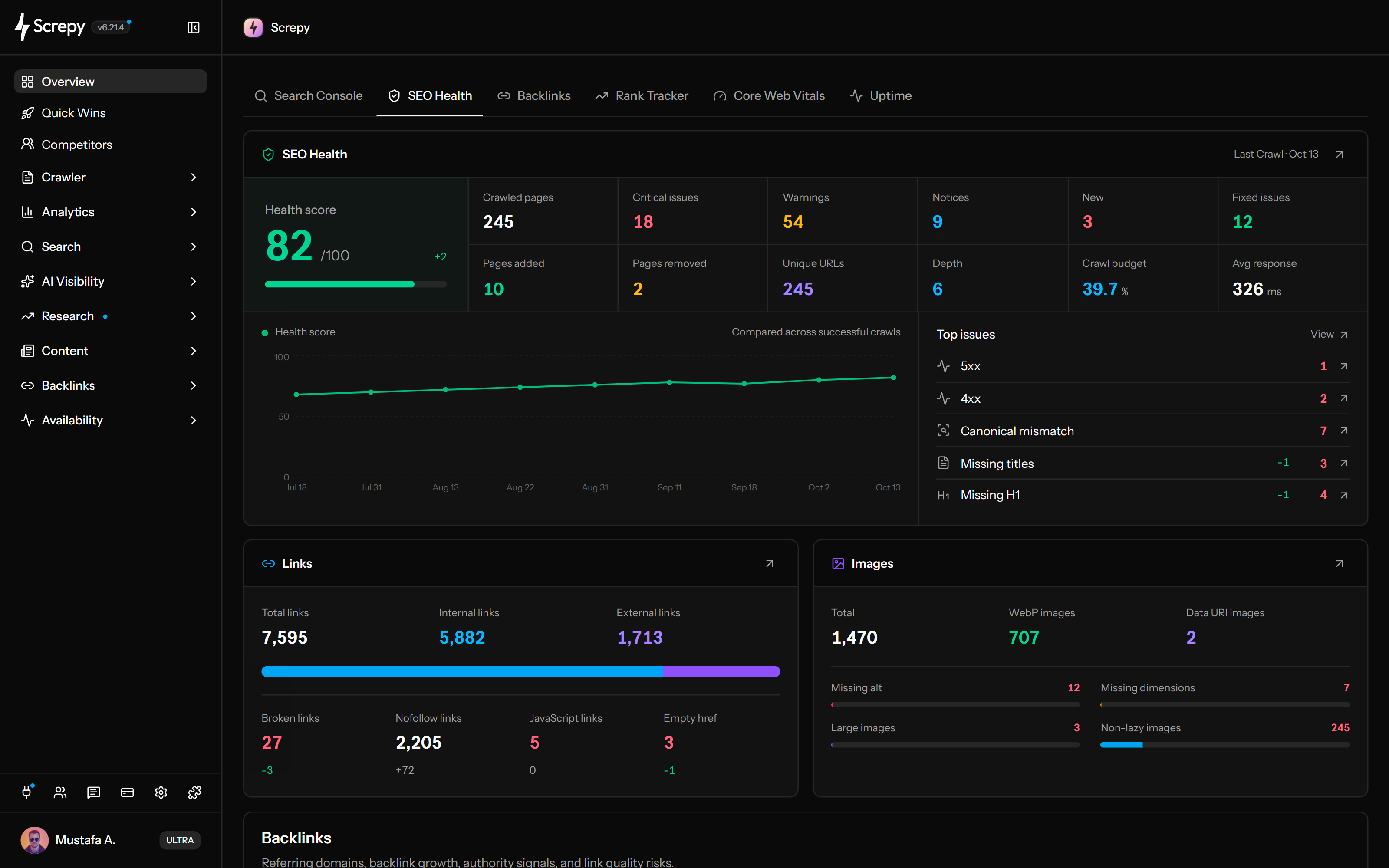










Screpy turns the latest successful website crawl into a 0–100 health score. Use it to spot changes in the measured technical conditions, then read the evidence behind the number.
example.comCompleted
The calculation uses the affected share of eligible pages, links or images and limits each signal’s penalty. Four weighted group scores form the total, so fixing ten issue instances does not always earn ten points.
Score weights
Read the high, medium or low confidence label before treating a score as representative. Confidence reflects page-limit and blocked-crawl signals; it is not a measured percentage of every URL on the website.
Confidence
HighThe audit chart follows health scores and issue counts across successful crawls. A release, a metadata edit or a different crawl scope can change the result; use the trend to choose what to investigate.
Health score
87 / 100
Use the score as an entry point into Website Audit, then inspect affected records and the business value of the pages. A low group score can point to a shared template problem rather than dozens of unrelated fixes.
/guides/seo200
Connect your AI assistant to Screpy’s SEO MCP server. Ask about your latest completed crawl, inspect affected pages and turn technical SEO findings into a clear order of work.
A useful score review starts with crawl comparability and ends with affected-record verification. Coverage, confidence, group weights, and the website context matter more than chasing a number alone.
Complete a crawl with enough page, link, and image coverage. Record the starting URL, page capacity, depth, JavaScript mode, access conditions, and site version so a later score can be compared fairly.
Check whether a score is available, then read its high, medium or low confidence label alongside crawled-page totals. Page limits and blocked URLs can reduce confidence; the label does not measure what percentage of the entire website was discovered.
Use the weighted score groups to find the largest opportunity, then review issue severity, affected URLs, links, or images. Confirm whether the cause is one record or a repeated template, route, content type, or component.
Publish the smallest correct fix, inspect it on the live website, and run another crawl with comparable scope. Confirm the group score, issue count, affected rate, and health trend changed for the intended reason.
The score is most useful when a team has a baseline, an owner, and a reason to investigate. Pair the summary with the affected URLs and the business importance of the pages before scheduling work.
Capture a baseline before a migration, redesign, navigation change, or shared-template release, then compare the next successful crawl using equivalent settings.
Use the score and issue trend as an early signal that routine publishing or engineering work changed the technical condition of the crawled site.
Start with the weighted group and high-severity issue affecting valuable pages, then open the underlying records instead of optimizing the number in isolation.
Pair the high-level score and delta with fixed, added, and remaining issues so clients and managers can see the work behind the direction of travel.
Use Technical SEO Score for a high-level crawl-health signal, Website Audit for site-wide investigation and verification, and the free checker for one live page.
Summarize four weighted health groups, coverage, confidence, issue direction, and successful-crawl history in one project view.
Open the complete Pages, Links, and Images evidence, investigate repeated patterns, export focused records, and recrawl after the fix.
Review metadata, headings, canonicals, links, images, structured data, accessibility, and technical signals for one public URL.
Screpy documentation
Use the Screpy guides to configure a comparable crawl, review affected pages, links, and images, and verify technical fixes in a later crawl.
Learn the concepts behind this workflow and apply them with practical SEO guidance.
Do Google's new CrUX ad metrics affect SEO? Learn what ad count, density, CPU and network weight measure, where to find the data, and what to check next.
Read articleRun 14 Shopify Hydrogen SEO checks across product, collection and market routes. Verify metadata, variants, sitemaps, redirects and the actual public response.
Read articlePlan 14 Sanity SEO fields with a reusable Studio schema, published-perspective GROQ and checks for slugs, image assets, authors and indexing controls.
Read articleLearn what SI SEO means, how to improve AI search visibility, and how to measure mentions, citations, visits, and business outcomes.
Read articleUnderstand the formula, category weights, eligible inputs, coverage, confidence, crawl comparison, prioritization, and what a website health score can—and cannot—prove.
A technical SEO score is a 0–100 summary of selected crawl findings. Screpy calculates the score from the latest completed crawl and keeps the underlying groups, issue counts, and affected records available so the number remains an entry point—not the diagnosis.
The latest successful crawl needs at least one page with a 2xx response and link and image collection enabled. If these requirements are not met, the score is unavailable. A missing score is not zero, and an unavailable result cannot produce a score-change comparison.
The dashboard shows high, medium or low confidence. This estimate considers whether the crawl reached its page limit and how much of the crawl was blocked. It is not a measured percentage of every page on your website. Even high confidence cannot confirm that unlinked or undiscovered URLs were audited.
Begin with a low-scoring weighted group, then identify the high-severity issue affecting valuable pages at meaningful scale. Inspect representative URLs and find the shared cause before changing templates, routes, metadata, links, images, or headers.
Yes. The score uses weighted groups and affected rates rather than treating every issue instance equally. A crawl can fix many low-impact records while adding a smaller number of heavily weighted problems, or it can cover a different website scope.
Technical SEO Score summarizes four weighted groups from the latest completed crawl. Website Audit is the investigation workflow: it exposes the Pages, Links, and Images inventories, issue details, source context, filters, exports, and later crawl evidence needed to understand and verify a fix.
A one-page checker reviews one live URL at one moment. Technical SEO Score summarizes eligible findings across a completed project crawl, so it can reveal repeated conditions and compare website health across successful crawls.
The current formula includes HTTP client and server errors, canonical issues, missing or duplicated metadata, missing H1 headings, thin-content signals, language mismatch, broken or invalid links, image accessibility and loading findings, and selected security headers.
Website edits can change the score, but a new crawl can also discover a different mix of pages, links and images. Compare crawl settings, page totals, confidence, group scores and affected records before attributing a change to a release. The displayed score delta requires available results from both crawls using the same scoring formula.
A higher comparable score generally means fewer of the measured conditions affected the crawled scope, but 100 is not automatically the best business priority. Review page value, issue severity, scale, user impact, confidence, and implementation risk before choosing the next fix.
The current calculation combines four weighted groups: crawlability at 40%, on-page content at 30%, links and images at 20%, and security headers at 10%. Each signal applies a capped penalty based on the affected share of its eligible pages, links, or images, and the weighted group scores produce the final 0–100 result.
No. Screpy provides those signals in separate monitoring and search workflows, but they are not inputs to the current Technical SEO Score formula. Keeping them separate prevents a performance, availability, or ranking metric from being presented as if it were a crawl-health calculation.
No. The score measures a defined set of technical and on-page crawl conditions. Search performance also depends on relevance, content quality, authority, competition, demand, indexing decisions, SERP presentation, and user behavior.