

Link building means earning references from other websites to pages on yours. The strongest starting point is a page that solves a real problem, paired with a publisher whose readers need that solution. Off-page SEO also includes reputation, mentions, and local visibility, but a mention, a backlink, and a ranking improvement are different outcomes. Choose a method around the resource you can offer, verify the source and destination, and measure what happens after publication.
A useful campaign has a clear path: reader need → useful asset → relevant publisher → editorial placement → verified outcome. The methods below cover different ways to create that path, from repairing existing references to publishing research and pitching an original contribution. You do not need to use all of them.
What link building contributes to off-page SEO
Link building creates a route between someone else's content and your page. That route can help readers discover your work, send relevant visitors, and provide search systems with context. Google describes link analysis and PageRank as part of its ranking systems. It does not publish a simple formula for the value of an individual backlink.
This makes the destination important. A link to a useful reference can serve a publisher's readers even when a link to your sales page would be out of place. Before asking anyone to link, decide which question your page answers and why an independent editor would point readers there.
Links, mentions, and local reputation
These forms of off-page exposure serve different purposes:
| Exposure | What it provides | What to check |
|---|---|---|
| Editorial backlink | A clickable reference to your page | Source context, destination, link relationship, referral activity |
| Unlinked brand mention | Recognition without a route to your website | Accuracy, audience, whether a link would help the reader |
| Business listing or local citation | A way to find and identify a real business | Correct details, relevant category, genuine listing eligibility |
| Customer review | Feedback that can inform prospective customers | Authenticity, response, platform rules |
| Interview or event appearance | Exposure to an interested audience | Published recap, accurate attribution, useful resources |
For local businesses, Google identifies relevance, distance, and prominence as factors in local ranking. Keep that context separate from broad claims about organic rankings. A business review and a link in a technical tutorial are not interchangeable signals.
What links can and cannot establish
A relevant link does not fix a page that is inaccessible, inaccurate, or unsuitable for the query. Nor does a high domain score establish that every page on that domain is a good outreach target. Review the actual linking page and the intended visitor journey.
AI search needs the same restraint. Google's guidance for AI features says foundational SEO practices still apply. It does not establish a rule that a particular backlink or brand mention will produce an AI citation. Our separate guide to backlinks and AI search examines that question in more detail.
If you need the terminology first, the backlinks and SEO primer explains the basics. Here, the practical job is deciding which opportunities deserve your time and how to turn them into useful, verifiable references.
How to judge a backlink opportunity
A worthwhile opportunity needs a reason for the specific source page to reference your specific destination. Start with that relationship before looking at scores.
| Check | Evidence worth pursuing | Reason to pause or reject |
|---|---|---|
| Audience fit | Readers face the problem your page solves | The site covers unrelated topics mainly to sell placements |
| Page context | Your resource supports a claim, task, or recommendation | Your link would be inserted into an unrelated sentence |
| Editorial choice | A responsible editor can accept, reject, and revise the reference | A seller promises arbitrary anchors on any topic |
| Destination usefulness | Readers can access the promised evidence or resource | A thin sales page, broken download, or forced signup blocks the answer |
| Publication quality | Identifiable ownership, coherent content, maintained references | Copied articles, misleading identities, or a network built around link sales |
| Practical outcome | You can explain who might click and what they would gain | The entire case depends on one third-party metric |
Use domain and page metrics to organize a list, not to override what you see. A small specialist publication may be an excellent audience match. A famous domain may contain a page that nobody would sensibly use to find your resource. Neither situation can be judged from the domain score alone.
An outreach request can still lead to an editorial link. What matters is whether the publisher independently decides the reference serves its readers. Asking politely does not make a placement non-editorial; paying for unqualified ranking credit or conditioning it on an exchange raises a different issue.
Also distinguish link quality from link attributes. A nofollow link can still be a useful referral. The nofollow, sponsored, and UGC guide explains the relationships those attributes describe. Do not demand that an editor remove an appropriate attribute simply to satisfy your SEO report.
Finally, avoid invented profile rules. There is no universal anchor-text ratio, domain-score minimum, or ideal number of links to earn per week in this workflow. Investigate how links arose and whether they make sense; a publicity-driven spike is not automatically a problem.
Choose a link building strategy that fits your resources
Start where you already have something useful to offer. A new business with no original dataset has different options from an established company whose research is being quoted without attribution.
The effort levels below are planning judgments, not cost or success benchmarks. Access to a relevant audience can matter more than the size of your budget.
| Your situation | Sensible starting methods | What you need first | Relative effort |
|---|---|---|---|
| New site with limited time | Genuine partner listings; one reusable checklist; a small resource-page campaign | Accurate business information and a resource worth recommending | Lower to moderate |
| Established brand already receiving coverage | Unlinked mentions; image attribution; recovery of broken destinations | A dated list of existing references | Lower, when references actually exist |
| Local business | Relevant associations, suppliers, community resources and events | Real eligibility or a genuine community relationship | Lower to moderate |
| E-commerce brand | Manufacturer stockist pages; original product-use guidance; sizing tools | Useful product information and actual supplier relationships | Moderate |
| B2B or SaaS company | Templates, practical tools, expert contributions and focused research | Credible expertise and a defined user problem | Moderate to higher |
| Organization with an analyst or research team | Original benchmarks, visual reports, co-created studies and research-led PR | Data rights, defensible methods, and editorial capacity | Higher |
Choose one primary method and one supporting method for an initial campaign. For example, a checklist can support both curated resource-page outreach and a relevant expert contribution. That is a coherent distribution plan; producing unrelated assets for every tactic is harder to learn from.
Before committing, write three sentences:
- Reader: Who needs this resource, and what are they trying to do?
- Publisher: Which pages already help that audience?
- Contribution: What can our page add that those pages do not already provide?
If the third sentence is only “our article is longer,” refine the resource. A better answer might be an editable worksheet, a transparent calculation, a missing implementation example, or a clear explanation of an exception.
For local campaigns, use the separate local link building guide. If you plan to outsource, evaluate the approach and deliverables with the link building service selection guide. Neither a provider's promised link count nor a directory's availability replaces editorial fit.
Find prospects and turn link gaps into a useful shortlist
Prospecting is the work of finding pages that could reasonably reference your asset. A spreadsheet of domains is only the beginning. For each candidate, you need a source URL, a reason for inclusion, an appropriate destination, and someone responsible for the page.
Search for the page type you need
Use searches that describe the resource and audience, rather than starting with “buy backlinks” or a generic guest-post list. These are illustrative queries for a web-performance checklist; replace the topic with your own.
| Query | What you are looking for | What to verify |
|---|---|---|
"web performance" "useful resources" |
A curated resource collection | Whether it recommends practical checklists |
"website launch" inurl:resources |
Launch-related resource pages | Audience, maintenance, external references |
"Core Web Vitals" "checklist" |
Guides that might need an implementation aid | Whether your checklist adds something specific |
"YourBrand" -site:yourdomain.com |
Existing mentions outside your site | Actual mention, current link, correct entity |
"YourProduct" "partners" |
Genuine partner or supplier references | Existing commercial relationship and listing eligibility |
"web performance" "contributor guidelines" |
Publications open to expert contributions | Editorial standards and a relevant, original angle |
Search results are a discovery sample. They are not a complete inventory of mentions or opportunities, and a result's presence does not prove that the page accepts submissions.
Open each page. Read the relevant section, follow its current references, and record exactly where your resource could help. A title match is insufficient: a technical paper, a beginner checklist, and a vendor comparison may discuss the same topic while serving very different needs.
Inspect competitor links at page level
Choose competitors that publish useful resources for the same audience. Inspect their linked pages and ask what the publisher was citing: a finding, a definition, a tool, a person, or a commercial relationship. You cannot reproduce a competitor's partnership simply because a backlink tool lists it.
In Screpy's Backlink Checker, an added competitor can be inspected for recorded sources, anchors, and destinations. Backlink Gap compares your project with one added competitor to surface recorded source domains absent from your profile. These are investigation leads; they do not establish why the publisher linked or whether it will link to you.
For a useful shortlist, keep these fields together:
- Source page and referring domain
- Existing reference and the question it answers
- Your proposed destination and concrete added value
- Responsible editor or maintainer
- Evidence checked and check date
- Pursue, revise the asset, or reject
Deduplicate contacts as well as domains. If one editor manages several relevant pages, send one coherent suggestion rather than separate automated messages for every URL. If automated classification helps organize a large list, the AI backlink analysis guide explains how to keep the final decision grounded in human checks.
Six link building methods using existing references and relationships
These methods begin with something that already exists: a reference, an image, a supplier relationship, or a real community connection. The examples in this and the next two method sections are illustrative, unless a public example is explicitly identified.
1. Recover links to broken or moved pages
Best fit: A site that has changed URLs, retired resources, or recently migrated.
Find external references to your own unavailable destinations and inspect the source page. If the original content remains useful, restore it. If it has a genuine successor, consider a direct permanent redirect to that successor. If the source contains a typo, give the publisher the correct URL.
For example, an old downloadable launch worksheet might now live on a resource page. The replacement should still let visitors obtain the worksheet.
Where it fails: Redirecting every discontinued URL to the homepage changes the promised destination. Recovery preserves an existing reference; it should not be reported as a newly acquired referring domain. Google's site-move guidance provides the broader migration framework.
2. Turn useful brand mentions into links
Best fit: Your business, research, or product already appears in relevant coverage.
Check whether the mention is actually unlinked and whether it identifies your organization correctly. Ask for the destination that makes the reference useful: the study being discussed, a product specification, or a company page when the mention is about the business itself.
A publisher describing your survey has a clearer reason to link to its methodology than to your pricing page.
Where it fails: Some publications deliberately avoid external links, and some mentions do not need one. Accept that decision. Coverage still has communication value; do not count it as a backlink or assign it an assumed ranking benefit.
3. Request attribution for original images
Best fit: You publish original charts, diagrams, photographs, or other visual work that others reuse.
Find uses of the visual through reverse-image discovery or searches for its title and distinctive caption. Verify that the image is yours and review the actual permission or attribution terms. Where a citation would help identify the source, suggest the original page.
For a chart, link readers to the page explaining its definitions, data, and limitations rather than just the image file.
Where it fails: A stock image you licensed may also be licensed by others. Similar imagery is not proof of copying. Do not invent a legal entitlement to a backlink or use threats as an outreach script.
4. Improve genuine partner and supplier listings
Best fit: You are an actual reseller, integration partner, customer, or service partner.
Review the organization's existing partner, stockist, integration, or customer pages. Check eligibility, outdated information, missing destinations, and whether the listing describes the real relationship. Supply accurate details and the page a visitor needs.
A product manufacturer listing an authorized retailer can help shoppers find availability. An integration directory can point to setup instructions instead of an unrelated marketing page.
Where it fails: Manufactured partnerships and compulsory link exchanges add little reader value. A real commercial relationship does not remove the need to describe compensated links appropriately.
5. Join relevant professional resource networks
Best fit: A genuine association, trade group, or professional community serves your audience.
Look at membership requirements and the way the organization presents members or recommended resources. Participate because the membership is useful, then maintain any listing you legitimately qualify for. An industry association may also need a practical training resource from a member.
Where it fails: Paying for membership solely because a seller advertises “high-authority backlinks” confuses a business decision with a ranking purchase. An unrelated directory is not improved by calling it an association. Evaluate the audience and terms, not the suffix of the domain.
6. Publish resources for real community events
Best fit: You actually organize, speak at, support, or contribute expertise to a relevant event.
Create something attendees can use: a workshop worksheet, an accessible slide summary, a local planning checklist, or a practical event recap. Give the organizer a stable resource URL for its program or follow-up material.
A web agency teaching a nonprofit website workshop could publish the checklist used during the session. The link has a clear purpose for attendees.
Where it fails: An event contribution does not entitle you to an editorial link. Paid sponsorship and independent resource recommendations are different arrangements. Keep the resource accessible after the event, and follow the advertising distinction below when compensation is involved.
Six content assets that give publishers a reason to link
A linkable asset is something another publisher can use as evidence, an explanation, or a practical next step. Choose the format after identifying that use. A calculator does not help a writer who needs an original finding, and a survey does not replace a downloadable implementation checklist.
7. Publish a small original research report
Best fit: You can answer a focused question with data you are entitled to use.
Start with a question your audience already discusses but cannot answer confidently. Publish the findings alongside enough methodological context for a reader to judge them. Make the relevant table or observation easy to locate.
A fictional agency might study which launch checks clients most often overlook. It must describe the actual sample rather than claiming to represent every website.
Where it fails: A weak or biased dataset does not become authoritative because the chart looks professional. If you cannot defend the interpretation, narrow the claim. Keep customer information private and avoid treating correlation as causation.
8. Curate statistics that resolve a specific question
Best fit: Writers need reliable numbers scattered across primary reports.
Organize a focused set of findings around a question, with the original source, measured period, definition, and relevant limitation attached to each. Explain why apparently conflicting figures differ rather than choosing the largest number.
For instance, a resource comparing mobile and desktop performance must retain the population and measurement conditions for each figure.
Where it fails: Recycling unsupported statistics from other roundups creates another weak intermediary. A new publication date does not make old data current. Your value is verification and interpretation, not a larger collection of numbers.
9. Build a useful calculator or free tool
Best fit: Users repeatedly perform a calculation, comparison, or diagnostic step.
Build the smallest tool that answers the question accurately. Explain inputs, assumptions, units, and how to interpret the output. Give publishers a stable page that combines the tool with its explanation.
An image-budget estimator could help a design tutorial turn a general performance recommendation into an actionable planning exercise. It should explain what the estimate omits.
Where it fails: Unclear assumptions, inaccessible inputs, or a login wall can make the proposed reference unsuitable. The interactive calculator guide covers the separate creation and SEO workflow.
10. Offer an editable template or checklist
Best fit: Your audience needs to complete a repeatable task.
Provide an asset people can actually use, with an example of a completed entry. An editable worksheet, review checklist, or handoff document can be easier for a publisher to recommend than another broad article.
For a launch checklist, show an evidence field and a decision field. “Check page speed” is vague; “record the test URL, condition, finding, and owner” gives the reader something to do.
Where it fails: A download that adds no value beyond the surrounding article is a weak offer. Test access and usability before pitching, and clearly state any signup requirement.
11. Create a guide that answers a difficult implementation question
Best fit: Existing coverage describes the concept but leaves a recurring practical problem unresolved.
Identify the point where readers get stuck. Add a worked example, prerequisite, exception, or troubleshooting path, then pitch it to pages whose readers encounter that problem.
The advantage might be explaining when a checklist item should be marked “not applicable,” rather than turning a short list into a long list.
Where it fails: “More comprehensive” alone is not a useful contribution. A separate page that repeats your existing guide can split maintenance and confuse readers. Update an existing resource when it already owns the question.
12. Make an original chart, diagram, or visual reference
Best fit: A relationship or process is difficult to explain with prose alone.
Create the visual for a specific explanation, include readable labels and a text equivalent, and publish it with the underlying context. Offer accurate attribution guidance if reuse is permitted.
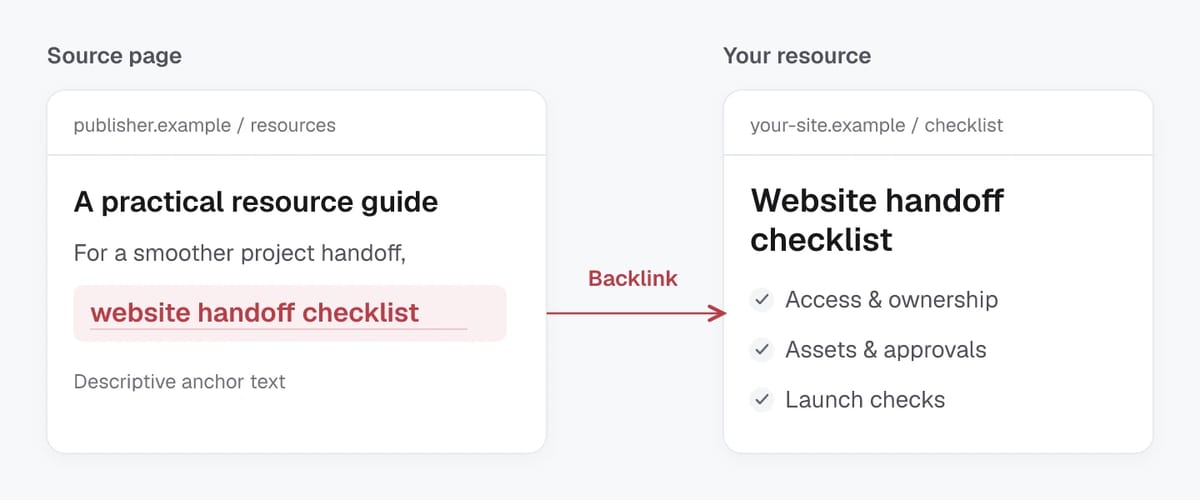
A diagram distinguishing a source page, a linked asset, and an internal next step can help a tutorial explain where an earned link actually points.
Where it fails: Decoration is not evidence. A chart with no definitions or source is difficult to cite responsibly; an image that becomes illegible on mobile is difficult to use.
Two public examples show useful reference design without implying that their approach guarantees backlinks:
| Public example | What you can inspect | Lesson for your asset |
|---|---|---|
| Google's Core Web Vitals article links to individual web.dev explanations beside the metric definitions | The placement connects a named concept with a deeper explanation | Make the destination answer the exact question at the linking sentence |
| HTTP Archive's 2024 performance chapter presents figures alongside explanatory and source context | Readers can inspect what the report measured and how findings are presented | Package evidence so a citation can be checked |
These are observations of public pages, not Screpy campaign results. They demonstrate reference usefulness and evidence packaging; they do not reveal the acquisition process or ranking value of a link.
Eight ways to earn editorial coverage for a useful asset
Once an asset exists, the next job is finding a publisher whose readers would benefit from it. These methods differ in the editorial reason for the reference. Match the pitch to that reason rather than sending the same “great resource” email to every website.
13. Suggest a resource for a maintained resource page
Best fit: A publication already curates useful material for the audience your asset serves.
Read the page and check whether it is maintained, accepts outside suggestions, and lists resources comparable to yours. Suggest the exact destination and explain the task it helps readers complete.
A launch checklist could belong in a small-business website handoff collection. It is less suitable for a directory devoted to developer research papers.
Where it fails: An abandoned list or a page created primarily to sell placements is a poor starting point. Relevance matters more than the word “resources” in its URL. The Ahrefs resource-page guide offers a deeper walkthrough of this specific method.
14. Replace a genuinely broken external reference
Best fit: A useful page cites an unavailable resource, and your asset can serve the same purpose.
Check the reference yourself. Identify what the missing destination was supposed to explain, then compare that requirement with your page. Report the broken URL and offer your alternative without implying that the publisher owes you a link.
A missing launch worksheet might be replaceable with a working worksheet. A missing research paper cannot be replaced adequately by a general SEO introduction.
Where it fails: A temporarily blocked page is not necessarily gone. A replacement that answers a different question makes the publisher's article worse, even if both pages mention the same keyword.
15. Offer a precise improvement to an outdated reference
Best fit: An existing reference works but misses information readers now need.
Identify the actual gap: an obsolete interface, unsupported instruction, missing exception, or unavailable download. Explain how your resource resolves that specific issue. The editor may choose to update the existing reference instead, which is a reasonable outcome.
The approach is sometimes associated with the “Skyscraper Technique.” Its useful part is improving the answer, not making a page longer and asking everyone linking to an older article to switch.
Where it fails: Calling another article outdated without checking its substance is weak outreach. A newer date or a larger word count does not establish a better reference.
16. Answer journalist and expert-source requests
Best fit: You have relevant experience, evidence, or subject expertise for a real request.
Read the question, deadline, intended attribution, and source requirements. Answer directly, identify your role honestly, and provide verifiable evidence where it helps. Disclose relevant commercial interests. Keep the response usable without requiring the journalist to rewrite a sales pitch.
For example, a developer could explain a documented launch mistake and its prevention, while removing customer-identifying details.
Where it fails: Invented credentials, generic AI-generated quotations, and answers outside your competence damage the contribution. A published quote may include your name without a backlink; check the result rather than promising one.
17. Explain a current development through reactive PR
Best fit: A new event creates a question your organization can answer credibly.
Find the unanswered question and contribute evidence or a practical interpretation while it is still useful. Verify the original announcement and distinguish confirmed changes from speculation. Contact writers covering that exact issue.
In a hypothetical standards change, a specialist could publish a short comparison of the old and new requirements, with a worked example and a clear scope boundary.
Where it fails: A generic reaction adds little to coverage. Rushing before the facts are established can create a misleading reference. If you have no useful contribution, do not force your brand into the event.
18. Contribute an original article to a relevant publication
Best fit: A publication accepts contributions and you can supply something its audience lacks.
Read its editorial guidelines and recent coverage. Propose a specific problem, an original example, and a credible author. Any reference to your own asset should help explain the contribution and remain subject to editorial approval.
A worked launch handoff example could suit an agency publication. Reposting your existing guide with a keyword-rich backlink adds little.
Where it fails: Scaled guest posting for ranking links, copied articles, and paid unqualified placements introduce policy and quality risks. Treat a contribution as publishing work, with its own evidence and review.
19. Share useful material through interviews and podcasts
Best fit: You have a relevant perspective and supporting resources for a show's audience.
Study the show's topic and format. Propose a useful discussion, then provide a small set of references that support it. Make your material understandable without listening to the entire episode.
An interview about failed website launches might naturally reference an editable handoff worksheet in the episode notes.
Where it fails: A biography link is different from an editorial reference to a resource. Neither is guaranteed. Invitations that require payment should be assessed as commercial arrangements, with appropriate link treatment rather than promised ranking value.
20. Co-create research or resources with a complementary organization
Best fit: Each collaborator brings a distinct, useful contribution.
Agree on the reader problem, responsibilities, data permissions, ownership, and publication plan before production. Publish a complete resource with transparent attribution. Decide which page is the canonical home so readers do not encounter conflicting versions.
An accessibility specialist and a web agency could create a handoff worksheet covering issues neither would explain fully alone.
Where it fails: A partnership built around exchanging keyword-rich links has little editorial substance. Participation does not require every collaborator to link, and commercial arrangements still need appropriate disclosure and link qualification.
A worked link building campaign from asset to verified placement
This fictional campaign shows how the decisions connect. The agency, prospects, URLs, and outcomes are illustrative; they are not Screpy customer results.
Define the destination and reader benefit
A web agency wants to reach business owners preparing to accept a finished website. Its commercial service page describes agency work, but a launch tutorial needs a resource readers can use immediately.
The agency therefore creates a handoff checklist at example.org/website-handoff-checklist/. Each row includes a task, test condition, evidence, decision, and owner. A completed sample shows how to record a redirect problem without exposing customer data.
The publisher benefit is specific: readers can turn a tutorial's recommendations into an acceptance record. Before outreach, the agency checks that the page loads, the worksheet is accessible, the example is understandable, and the URL is intended to remain stable.
Qualify prospects before writing emails
The first shortlist contains three candidate pages:
| Candidate | Relevant observation | Decision |
|---|---|---|
| A maintained small-business launch tutorial | Recommends documenting handoff checks but offers no worksheet | Keep; suggest the checklist beside that instruction |
| A prominent publication's general funding news article | Has a large audience but no website launch context | Reject; prominence does not resolve the topic mismatch |
| An agency tutorial with a broken link to a performance benchmark | Needs evidence for a numerical claim | Reject for this asset; a handoff checklist cannot substantiate the statistic |
This last rejection matters. The agency should not pitch the wrong replacement simply because it found a broken link. It can investigate a separate, suitable source later.
For the retained prospect, the agency records the source URL, relevant sentence, editorial contact route, proposed destination, and reason the resource helps. It checks published contributor or resource policies before contacting anyone.
Publish, pitch, and verify the placement
The campaign has two connected paths:
| Editorial path | Reader path |
|---|---|
| Useful checklist → relevant tutorial → specific pitch → editor's decision | Tutorial → checklist → appropriate next step on the agency site |
The first path describes acquisition work. The second describes what a visitor can do after a reference exists. Neither path guarantees search rankings.
The agency sends a short resource suggestion identifying the missing worksheet and its intended use. It does not demand an anchor phrase, a “dofollow” link, or a placement in exchange for another link.
If an editor replies that the checklist is too technical, the agency asks which instruction caused confusion. If the feedback reveals a genuine usability problem, it improves the asset. It does not manufacture a new version merely to have another reason to send an email.
If a reference is added, the agency opens the actual source page and records:
- The exact linking page and final destination.
- The surrounding sentence and whether the reference is useful in context.
- The link's HTML attributes and any redirect.
- The date it verified the placement, separate from a tool's discovery date.
- Referral visits and later outcomes when measurement is available.
If only a brand mention appears, it records a mention rather than a backlink. If the publisher declines, it closes that prospect rather than escalating the same request.
The next campaign decision comes from the evidence: refine the asset, improve prospect fit, change the pitch, or stop. Sending more emails is only useful after identifying which stage needs improvement.
Outreach emails that match the reason for the link
A useful outreach email gives the recipient enough information to make an editorial decision: the page you mean, the reader need, the contribution, and the proposed destination. The Ahrefs outreach guide provides additional context on finding the responsible person and making a relevant request.
The examples below use the fictional campaign. Replace every bracketed field with a checked fact. Use a genuine contact route and identify yourself honestly; a template is a starting point, not permission to send unsolicited bulk messages.
Resource page suggestion
Subject: Handoff worksheet for your website launch resources
Hi [name],
Your [page title] recommends documenting launch checks before accepting a finished website. I work at [agency], and we created an editable handoff checklist with a completed example.
It could help readers turn that instruction into a record of evidence, decisions, and owners: [resource URL].
Would it be useful beside the handoff section?
[Name and role]
The specific placement and practical use explain the request. Remove the suggestion if the page already offers an equivalent worksheet.
Broken reference replacement
Subject: Unavailable worksheet in [page title]
Hi [name],
The worksheet linked from “[checked sentence or link text]” on [source page URL] returned [verified result] when I checked on [date].
We publish a working handoff worksheet at [replacement URL]. It covers [specific overlapping task], although [important difference, if any].
If you are updating that reference, it may be an option.
[Name and role]
Report what you observed rather than declaring the entire website dead. Be explicit about material differences; a replacement that cannot support the source sentence should not be offered.
Unlinked mention request
Subject: Resource mentioned in [page title]
Hi [name],
Your [page URL] mentions [our named worksheet] in the handoff section. I am [name and role] at [agency].
The worksheet is available at [canonical resource URL]. If your linking policy allows it, a reference there would let readers open the worksheet you describe.
Thank you,
[Name]
This request depends on a real, checked mention of your resource. Do not use it for a generic mention of an unrelated entity with the same name.
Research or expert contribution pitch
Subject: Evidence for your question about [specific issue]
Hi [name],
I saw your request for [exact question]. My role is [accurate role], and my relevant experience is [verifiable experience].
Our findings suggest [bounded observation], based on [actual sample and period]. The method and limitation are at [report URL].
The point that may help your readers is [one concise interpretation]. I can clarify the method or attribution before your deadline.
[Name and role]
Use the research version only when that evidence exists. For an expert response, replace the findings with a direct answer and its basis. Do not invent a dataset to make the pitch sound stronger.
If you follow up, one brief reminder after a few business days is a reasonable editorial starting point, not a proven optimal interval. Add relevant information rather than repeating the same demand. Stop after a decline or an opt-out, and respect applicable contact rules.
Track delivery, replies, and placements separately. An email sent to the wrong person has not meaningfully tested whether the resource is useful.
Link building tactics to avoid and warning signs to investigate
An opportunity is not safe merely because a seller calls it editorial. Evaluate the arrangement and the actual link, not the package name.
Separate advertising from ranking-link purchases
Google's link-spam policy identifies links created primarily to manipulate rankings as spam. Its examples include ranking-link purchases, excessive exchanges, automated link creation, and low-quality directory links. Advertising and sponsorship can be legitimate when the links are appropriately qualified.
| Arrangement | Decision |
|---|---|
| Paid advertising reaching a relevant audience | Assess the advertising value and qualify the link |
| A seller guarantees an unqualified link for ranking credit | Decline the ranking-link offer |
| A relevant editor chooses to cite useful evidence | Check the actual context and destination |
| An automated service posts optimized links in comments or directories | Avoid the campaign |
| A network offers bulk guest posts with repeated keyword anchors | Investigate the publishing arrangement; do not treat volume as editorial merit |
Google's outbound-link guidance prefers rel="sponsored" for paid placements; nofollow remains acceptable. Links in user-generated content can use ugc. Qualification addresses the link relationship; it does not turn an irrelevant page into a worthwhile marketing opportunity.
A natural partnership can involve mutual references, but an excessive exchange made for ranking manipulation is different. A brand name, contextual citation, or descriptive anchor chosen by an editor is preferable to insisting on an exact keyword phrase.
Do not turn every suspicious link into a removal project
A backlink report may contain unexpected domains, duplicate pages, or links that look unhelpful. A low proprietary score does not establish that a link caused a ranking decline.
Inspect the source, your involvement, and any relevant Search Console manual-action information before choosing a response. Keep risk investigation separate from acquiring useful references.
Google's disavow guidance says most sites do not need the tool and warns that misuse can harm performance. It describes use where there are considerable spammy or artificial links and they have caused, or are likely to cause, a manual action.
Do not upload a disavow file automatically because a tool labels links “toxic.” Preserve the evidence and make a specific, justified decision about the actual issue.
Measure link building results and maintain the pages that earned them
Measurement should distinguish work completed, references published, visitors received, and business outcomes. A link count alone cannot show whether a campaign reached the right audience or caused a search improvement.
Keep a campaign log
Record prospects before contact and verify placements after publication. A practical tracker separates four kinds of evidence:
| Record | Essential fields | Why it matters |
|---|---|---|
| Opportunity | Source URL, contact, audience fit, proposed destination, method, owner | Preserves the reason you selected the prospect |
| Outreach | Sent date, delivery status, follow-up, reply, next action | Separates contacted prospects from actual responses |
| Placement | Source URL, final target, context, attributes, verification date, new referring domain or existing domain | Distinguishes a checked reference from a promised one |
| Outcome | Referral visits, meaningful actions, conversions, cost, search observations and other changes | Connects the work to measurable results without assuming causation |
A filled example might read: “Launch tutorial; resource suggestion; checklist destination; delivered October 14; editor requested simpler wording; revised asset; placement pending.” That is progress, but it is not a backlink.
Keep rejected prospects and reasons too. Repeated topic mismatches suggest a prospecting problem; repeated usability objections suggest an asset problem. A small sample may only suggest questions to investigate, not a dependable conversion rate.
Calculate efficiency without overstating causation
Suppose the fictional campaign has 30 qualified prospects, 20 delivered emails, five replies, and three verified new placements across two referring domains. Two placements are on different pages of the same domain. These are invented numbers for explaining the calculation.
| Measure | Calculation | Interpretation |
|---|---|---|
| Reply rate | 5 ÷ 20 = 25% | Replies per delivered email; a reply is not necessarily positive |
| Placement rate | 3 ÷ 20 = 15% | Verified placements per delivered email |
| New referring domains | 2 | Distinct domains first linking in this campaign; not three domains |
| Recorded cost per placement | $400 ÷ 3 = $133.33 | Cost efficiency under the stated assumptions, not financial return |
The $400 assumes ten total hours for asset creation, prospecting, outreach, and checking at $40 per hour, with no additional spending. Include other real costs when they exist. Track recovered old links separately from new placements so a repair does not inflate acquisition totals.
To assess return, you also need attributable business value and a defensible attribution method. Compare referral behavior and relevant conversions with search visibility over time. In Search Console, inspect the destination's clicks, impressions, queries, and average position in comparable periods. Annotate content edits, technical changes, seasonality, and other campaigns; a ranking increase after a link appears does not prove that link caused it.
Screpy's Backlink Checker can help organize recorded backlink evidence. Its Net Gain shows net movement, not a complete list of individually acquired and lost links. First Seen is a discovery date, not necessarily the publication date. Verify important placements on their source pages. Its export contains the currently loaded page of rows, so do not assume that one export represents the whole profile.
Connect earned resources to useful next steps
A visitor landing on your study or worksheet may need a related guide, tool, or service. Add an internal reference where it answers the next question. Describe the destination accurately rather than inserting a fixed number of links to commercial pages.
Google's link best practices support crawlable links with useful context and descriptive anchor text. Our guide to internal linking mistakes covers the broader site workflow.
Keep valuable resource URLs stable. If one must move, map it to the relevant successor, update internal references, and follow the site-move guidance. Do not redirect every old resource to the homepage.
Revisit important references when your resource changes or monitoring suggests a loss. Check whether the source removed the link, changed its destination, moved, or became temporarily inaccessible before contacting its maintainer. Keep local listings accurate and attribution consistent when those channels are part of your strategy.
Begin with one useful asset and a short, justified prospect list. The campaign log will show which decisions to improve before you expand the work.