

Review prioritized opportunities instead of treating every warning as equally important.
SEO Software for Small Businesses
Understand what is holding your website back, choose a manageable next step, and monitor the search and site-health signals that matter to your business.
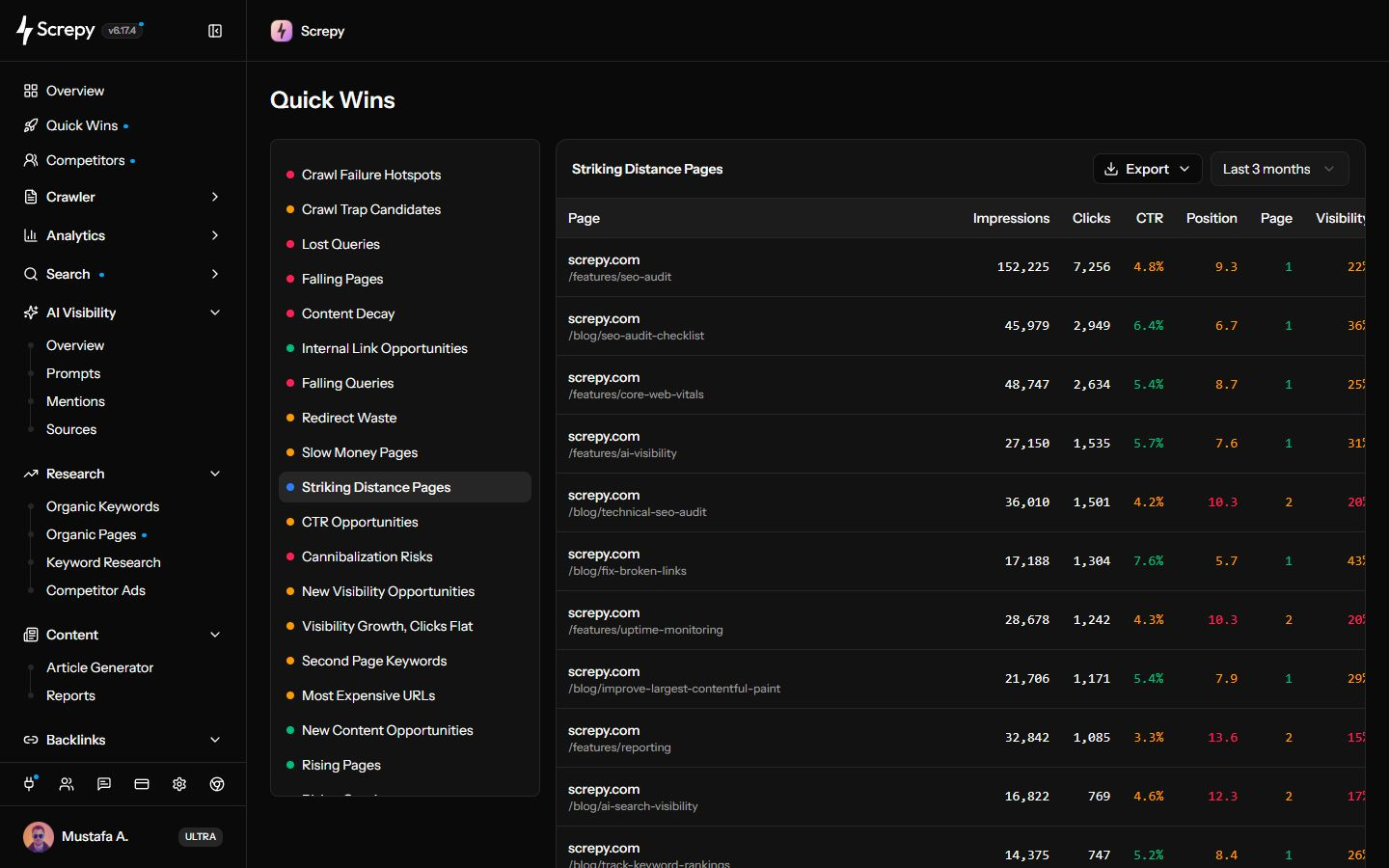










Small businesses need priorities, not an endless SEO checklist
Limited time makes broad audit lists difficult to act on. Screpy helps connect website findings to important pages, search demand, and a realistic order of work.
Find template and navigation issues affecting many pages, then fix the shared cause where possible.
Monitor a focused set of customer-relevant keywords rather than checking anonymous results by hand.
Understand what is hurting your search visibility
Start with a crawl of the public website. Review whether important pages can be reached, whether titles and headings explain the page, and whether links, redirects, images, canonicals, or response errors create avoidable friction.
Learn more about website audit- See the affected pages behind each issue instead of a score alone.
- Look for repeated patterns before editing pages one at a time.
- Share concrete evidence with the person responsible for the website.
Start with the SEO fixes that matter most
Use available crawl, Search Console, and website data to identify focused opportunities. A useful priority connects the problem to a page, a measurable signal, and an action the business can realistically complete.
Learn more about quick wins- Review pages already receiving impressions before publishing more content.
- Find internal-link and content opportunities supported by current evidence.
- Treat recommendations as decisions to review, not automatic guarantees.
Monitor rankings without checking them manually
Add the search terms that reflect your products, services, and locations. Track them with consistent country, language, device, and optional location settings so changes are easier to compare over time.
Learn more about rank tracker- Keep the keyword set small enough to support actual business decisions.
- Review which URL ranks instead of watching the position alone.
- Use Search Console alongside tracking when query and click context is needed.
Protect PageSpeed and website availability
Monitor the public pages that support leads or sales. Recurring PageSpeed, Core Web Vitals, and uptime checks can reveal regressions or outages that deserve investigation before they become a long-running customer problem.
Learn more about performance and uptime- Watch the homepage, primary service pages, and other high-value entry points.
- Compare performance after design, plugin, or hosting changes.
- Escalate incidents with timestamps and response evidence.
A practical weekly SEO routine for a small business
A short review every week is more useful than collecting a large report that nobody has time to implement.
-
Check important website alerts
Confirm the site is available and review new crawl, broken-link, or performance issues on pages that support leads and sales.
-
Review search visibility
Look at the tracked keywords and Search Console pages that matter to the business, then note material changes rather than daily noise.
-
Choose one meaningful improvement
Select a fix with a clear owner, affected page, expected benefit, and completion condition.
-
Make or assign the change
Update content you own or send a developer precise URLs and evidence for technical work.
-
Check the result later
Revisit the page, crawl, rankings, or performance after enough time has passed to see whether the intended condition changed.
Small business SEO use cases
Use Screpy around concrete website decisions instead of trying to turn every available metric into a task.
Check whether launch pages are crawlable, internally linked, descriptive, and technically healthy.
Follow the customer searches and landing pages tied to each service area.
Review the highest-priority issues and opportunities without repeating a full manual checklist.
Send affected URLs, response details, and issue evidence instead of a vague request to fix SEO.
Compare the relevant page, search, or performance signal after a change while accounting for normal variability.
Check one important public URL before deciding whether the website needs a broader audit.
Know when a specialist is still needed
Screpy helps a small business find, monitor, and communicate SEO work. It does not replace strategy, development, writing, or local-business operations when those skills are required to solve the underlying problem.
- Use Screpy to understand the website and ask better questions before buying outside help.
- Bring in a developer for template, server, structured-data, or migration work beyond your access.
- Use an SEO specialist when competition, site history, or business strategy needs deeper investigation.
- Judge the work by business-relevant pages and outcomes, not by chasing a perfect audit score.
e1
example.comOwner
MKe2
example.orgMember
ALe3
example.netMember
JDSEO guides for small businesses
Continue with practical guides related to the website, search, and reporting workflows on this page.
SEO
What SEO Alerts Should You Monitor Before Traffic Drops
Choose SEO alerts for indexing, rankings and organic traffic. Set useful GA4 rules, verify site changes, and triage warnings with clear owners and evidence.
Read article SEO
Are Google Rank Tracking Tools Still Accurate?
Can you trust Google rank tracking tools? Learn how to check suspicious drops, distinguish collection issues, and compare positions with Search Console.
Read article SEO
How Can AI Improve Keyword Rank Tracking?
AI keyword rank tracking automates SERP monitoring, flags ranking volatility and competitor gaps, and prioritizes SEO actions by device and location.
Read article SEO
What Is a URL Audit and How Do You Perform One?
URL audit checks reveal crawlability, indexation, redirects, canonical tags, and internal-link issues, so teams can prioritize practical core SEO fixes.
Read articleRelated SEO solutions
Explore the closest Screpy workflows for teams with overlapping responsibilities.
Build a technical baseline, choose realistic opportunities, and measure early organic growth.
Move from prospect review to evidence-backed delivery and reusable client reports.
Small business SEO software FAQ
Straight answers about audits, rankings, technical work, and maintaining SEO with a small team.
What should a small business monitor first?
Start with the pages that generate enquiries or sales, the searches customers use to find them, website availability, and technical issues that block crawling or create a poor user journey.
Does an SEO score guarantee higher Google rankings?
No. An audit score summarizes selected technical signals; it is not a ranking guarantee. Use the underlying findings to improve the website and measure relevant search and business outcomes separately.
Can Screpy analyze a website before I create an account?
The free Website Analyzer checks one public URL without an account. A full-site project and ongoing monitoring require an account and are subject to current plan limits.
How often should a small business review SEO?
A focused weekly or monthly review is often more actionable than daily checking. The right cadence depends on how frequently the website changes, the importance of organic acquisition, and who can implement the work.
Can Screpy show which pages appear in Google Search?
A connected Search Console account can show available clicks, impressions, queries, pages, CTR, and average position. Index Status and crawl reports provide different technical context and should not be treated as identical data sources.
Can a small business do SEO with Screpy without an agency?
Screpy can help an owner or small team identify issues, choose priorities, and monitor changes. Some fixes still require writing, development, local SEO, or strategic expertise that the business may decide to handle internally or hire out.