

Start with a focused page review, then reserve the deeper crawl for opportunities that become real projects.
SEO Tools for Freelancers
Review a prospect, organize client evidence, monitor agreed outcomes, and report progress without paying for an enterprise stack you do not need.










Freelance SEO needs leverage without unnecessary complexity
A freelancer has to sell, investigate, deliver, and communicate. The right tool should shorten those transitions rather than add another dashboard to maintain.
Keep recommendations, monitoring settings, and historical evidence connected to the right website and market.
Turn current project data into a structured report that connects work completed with remaining priorities.
Turn a prospect website into a focused SEO audit
Use the free page analyzer to review one public URL before the first call. Check metadata, headings, canonicals, links, images, structured data, accessibility, and technical signals, then decide whether a full crawl is justified.
Learn more about on-page seo audit- Lead with the issues visible on the page being discussed.
- Avoid promising a complete site diagnosis from one URL.
- Use the review to define a specific next step, not a generic fear-based score.
Keep every client’s work organized
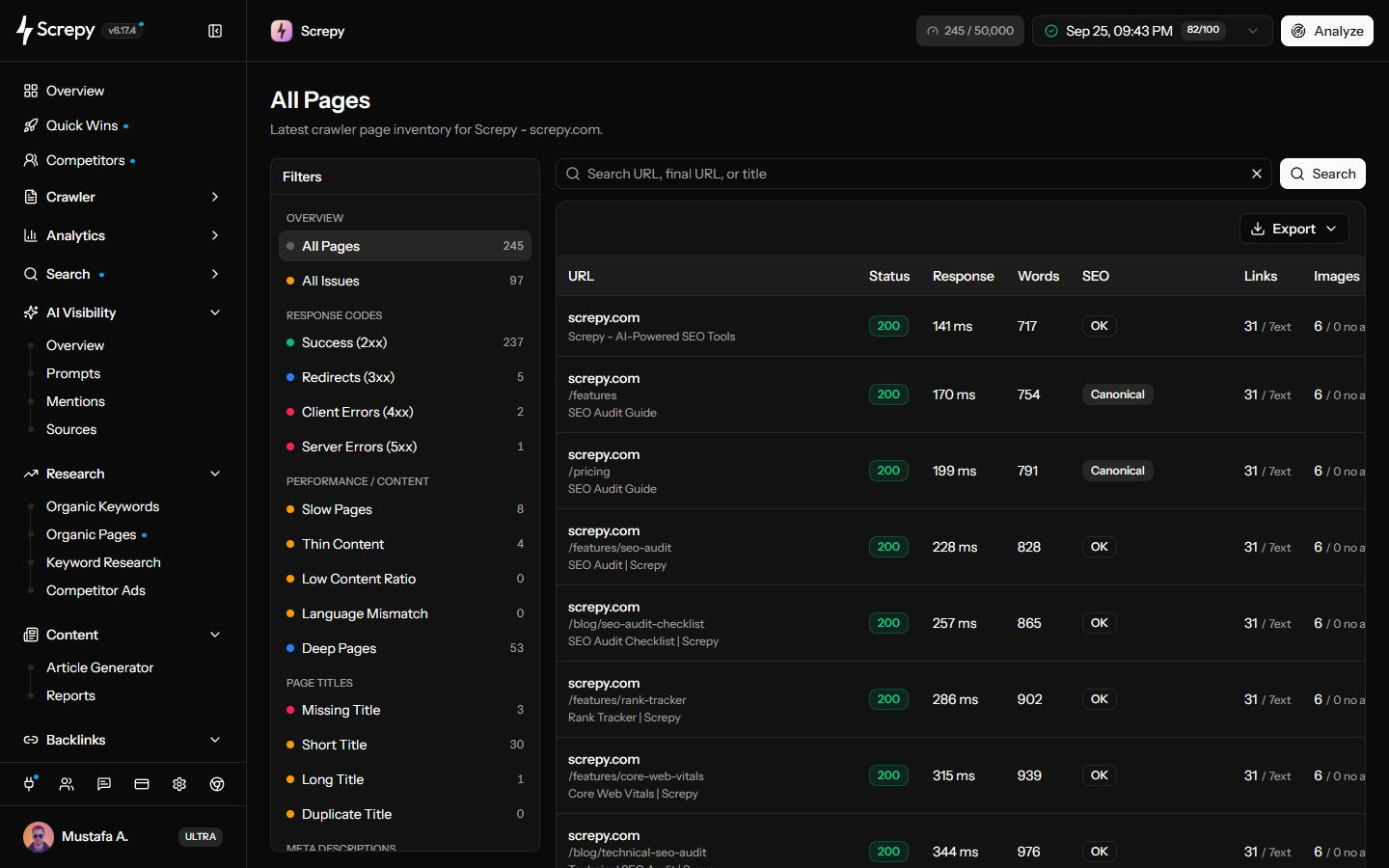
Move qualified work into a dedicated project. Store the website configuration, crawl history, selected search market, tracked keywords, and reports together so the next review begins with context rather than another setup exercise.
Learn more about project workspace- Separate one-off audits from recurring consulting accounts.
- Keep client-specific settings and evidence out of shared spreadsheets.
- Revisit prior findings when scope expands or a renewal approaches.
Build recommendations from current website data
Combine crawl findings with selected keyword rankings, Search Console performance, and monitored site health when those sources are available. Use each source for the question it can answer instead of treating every metric as proof of impact.
Learn more about website and search evidence- Show which URLs and queries are connected to an opportunity.
- Prioritize recurring or commercially relevant problems over cosmetic cleanup.
- Separate observed changes from hypotheses that still need validation.
Report progress without rebuilding presentations
Create reusable report templates around the services you deliver. Populate them with current project widgets, add concise client-facing context, and generate a dated PDF for the review call.
Learn more about seo reports- Use a repeatable structure while keeping the interpretation client-specific.
- Show the work completed, the evidence available, and the next priority.
- Preserve a point-in-time record without manually rebuilding charts.
A freelance workflow from discovery to renewal
Keep each stage small enough for one specialist to operate while making the value of the engagement visible to the client.
-
Qualify the opportunity
Review the prospect’s important URL, business model, market, and visible search problem before proposing a broad audit.
-
Define the baseline
Create the client project, crawl the agreed scope, record priority pages and keywords, and note what the current data can and cannot establish.
-
Deliver the first recommendations
Select a short set of fixes tied to evidence, expected user or search impact, ownership, and a clear completion condition.
-
Monitor the agreed outcomes
Track only the keywords, URLs, performance checks, and availability signals included in the engagement rather than generating unused data.
-
Prepare the renewal conversation
Report completed work and material movement, explain unresolved constraints, and propose the next scope from current evidence.
Freelance SEO work Screpy can support
Use the same project evidence across selling, delivery, verification, and reporting without pretending every engagement needs the same depth.
Find a credible conversation starter on a priority page before offering a larger engagement.
Crawl the agreed site scope, document recurring patterns, and hand off a prioritized fix list.
Review selected rankings and website health alongside the implementation backlog.
Use query, page, and keyword evidence to choose existing URLs that deserve revision before adding more content.
Check important templates and paths before and after launch, then document regressions for the delivery team.
Check whether a client-dashboard platform or Screpy’s focused audit and reporting workflow better fits your roster.
When Screpy fits your client roster
Screpy fits freelancers who need repeatable website audits, focused monitoring, and clear reporting across a manageable set of clients. A specialist database or enterprise platform may still be appropriate when research depth is the core deliverable.
- Useful for independent consultants balancing sales, delivery, and client communication.
- Strongest when recurring evidence matters more than maintaining a large tool stack.
- Not a substitute for specialist expertise, implementation ownership, or every enterprise dataset.
- Compare the client-delivery workflow with AgencyAnalytics if dashboards and integrations dominate the brief.
e1
example.comOwner
MKe2
example.orgMember
ALe3
example.netMember
JDSEO guides for freelancers
Continue with practical guides related to the website, search, and reporting workflows on this page.
SEO
Are Google Rank Tracking Tools Still Accurate?
Can you trust Google rank tracking tools? Learn how to check suspicious drops, distinguish collection issues, and compare positions with Search Console.
Read article SEO
How Can AI Improve Keyword Rank Tracking?
AI keyword rank tracking automates SERP monitoring, flags ranking volatility and competitor gaps, and prioritizes SEO actions by device and location.
Read article SEO
What Is a URL Audit and How Do You Perform One?
URL audit checks reveal crawlability, indexation, redirects, canonical tags, and internal-link issues, so teams can prioritize practical core SEO fixes.
Read article SEO
How Rank Tracking Works and What to Watch
Rank tracking shows keyword positions by location and device; watch SERP features, daily refresh timing, target URL swaps, and sampling that skew reports.
Read articleRelated SEO solutions
Explore the closest Screpy workflows for teams with overlapping responsibilities.
Manage audits, rankings, monitoring, and client reporting across separate projects.
Find practical website priorities and monitor search health without a complex SEO stack.
SEO tools for freelancers FAQ
Answers about prospect audits, client projects, reporting, and choosing a focused freelance SEO stack.
Can I keep client websites separate?
Yes. Each website can be organized as its own project with distinct settings, crawl history, keywords, and reports. Current project and team limits are listed on the pricing page.
Does Screpy replace a keyword research database?
Screpy includes keyword and competitor research workflows, but freelancers who sell large-scale market research may still need a specialist database. Use Screpy where its audit, monitoring, and reporting scope matches the engagement.
Is Screpy suitable for one-off audits and monthly retainers?
It can support both. A one-off audit can establish and document the current state, while a recurring project can add ranking, performance, uptime, and comparable crawl history.
Do my clients need their own Screpy account?
Not necessarily for every delivery model. You can generate reports for review, while collaborative access depends on the workflow and current plan conditions you choose.
Can I create a report with my own interpretation?
Yes. Report templates support selected project widgets and client-facing copy, allowing you to explain the findings and next actions rather than sending raw metrics alone.
Can I use Screpy for a prospect audit before creating a client project?
Yes. The free Website Analyzer reviews one public URL without an account. A full website audit is more appropriate after the prospect authorizes a broader crawl and the engagement scope is clear.