

Capture the current crawl and page structure before rapid publishing makes the root cause harder to isolate.
SEO Tools for Startups
Establish a clean SEO baseline, choose search opportunities your team can pursue, and catch launch regressions before early organic growth becomes harder to recover.









Early SEO decisions compound as a startup grows
A weak URL structure, unclear page purpose, or unmeasured release may look small at launch and become expensive after content, integrations, and product pages multiply.
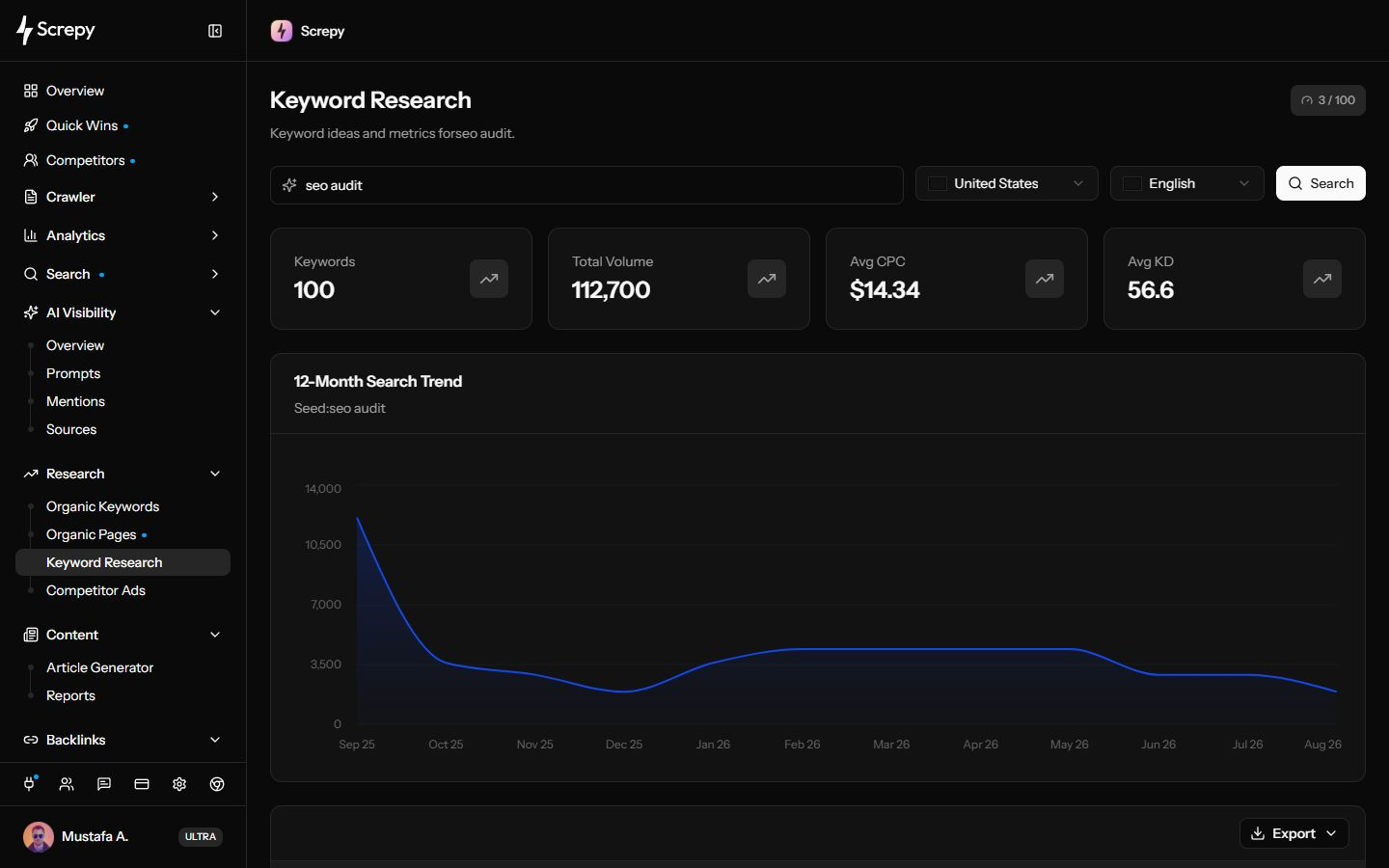
Compare demand, intent, difficulty, and the current results before committing limited writing and engineering time.
Monitor important landing pages for crawl, speed, and availability regressions around product launches.
Build a clean SEO baseline before content scales
Crawl the public website while its structure is still manageable. Review indexable pages, internal paths, metadata, canonicals, broken links, images, and response behavior, then document the few systemic decisions worth fixing early.
Learn more about website audit- Confirm that product, use-case, pricing, documentation, and resource pages are reachable.
- Fix shared templates before more URLs inherit the same issue.
- Record the baseline before a redesign, framework change, or migration.
Choose opportunities a small team can realistically pursue
Start from the problem the product solves, then research how the market describes it. Compare intent, volume, competition, difficulty, trends, and live results before selecting a page or content cluster.
Learn more about keyword research- Prefer topics where the product has direct expertise or useful evidence.
- Separate landing-page intent from educational content intent.
- Check whether an existing page can be improved before creating another URL.
Catch launch and migration mistakes early
Releases can change titles, canonicals, internal links, rendering, redirects, page speed, and availability. Recheck the affected templates and priority URLs while the team still remembers what changed.
Learn more about launch monitoring- Define which acquisition pages and routes are at risk before deployment.
- Compare current crawl and performance evidence with the previous state.
- Send regressions to engineering with exact URLs and observable conditions.
Measure early visibility without an enterprise stack
Track the small set of categories, use cases, and branded terms that explain whether the startup is becoming discoverable. Pair consistent rank tracking with Search Console impressions, pages, and queries when available.
Learn more about search visibility- Group tracked terms by product category, use case, or funnel stage.
- Review the ranking URL as well as the reported position.
- Treat early volatility as context, not proof that every change worked or failed.
A focused 30-day startup SEO workflow
Use the first month to establish reliable foundations and one defendable acquisition experiment rather than launching a large publishing program blindly.
-
Map the product and audience
Define the category, problems, use cases, proof, and pages the website needs to explain before selecting keywords.
-
Capture the technical baseline
Crawl the current site, check priority URLs, and fix structural issues that would otherwise be copied into future pages.
-
Select one search opportunity
Research intent and live competitors, decide whether to improve an existing page or create a new one, and define the useful outcome for the reader.
-
Publish and protect the page
Add internal links, verify indexable signals, and monitor the route after release for crawl, performance, or availability problems.
-
Review early evidence
Examine impressions, ranking movement, page engagement available to your team, and qualitative sales feedback before deciding what to repeat.
Startup SEO moments Screpy supports
Apply the workspace when the team is making a structural, publishing, or measurement decision that will affect future organic acquisition.
Confirm that the first commercial pages explain the product and can be crawled, linked, and monitored.
Establish indexable routes, internal paths, canonicals, redirects, and a baseline before promotion begins.
Choose one audience problem, map distinct intent, and connect the educational pages to the relevant product route.
Review important URLs and technical signals before and after the domain, framework, or information architecture changes.
Give founders and investors a concise view of visibility, work completed, current constraints, and the next experiment.
Compare low-cost keyword research, audits, rankings, content workflows, monitoring, and broader product scope.
Where Screpy fits and where specialists remain useful
Screpy is a focused, lower-cost workspace for startups building an audit, research, monitoring, and reporting routine. It does not replace product positioning, customer research, development, or every enterprise keyword and backlink dataset.
- Use Screpy when one small team owns both website changes and early acquisition experiments.
- Add specialist research only when the decision requires data outside Screpy’s current scope.
- Bring in technical expertise for rendering, migrations, internationalization, or infrastructure changes the team cannot safely implement.
- Compare Screpy with Ubersuggest if low-cost keyword research is the main buying question.
e1
example.comOwner
MKe2
example.orgMember
ALe3
example.netMember
JDSEO guides for startups
Continue with practical guides related to the website, search, and reporting workflows on this page.
SEO
Are Google Rank Tracking Tools Still Accurate?
Can you trust Google rank tracking tools? Learn how to check suspicious drops, distinguish collection issues, and compare positions with Search Console.
Read article SEO
Keyword Research With MCP: Search Volumes, SERPs, and Content Gaps
Use MCP for keyword research with real search-volume and SERP examples, then combine market data with Search Console to identify useful content gaps.
Read article SEO
How Can AI Improve Keyword Rank Tracking?
AI keyword rank tracking automates SERP monitoring, flags ranking volatility and competitor gaps, and prioritizes SEO actions by device and location.
Read article SEO
How Rank Tracking Works and What to Watch
Rank tracking shows keyword positions by location and device; watch SERP features, daily refresh timing, target URL swaps, and sampling that skew reports.
Read articleRelated SEO solutions
Explore the closest Screpy workflows for teams with overlapping responsibilities.
Monitor product-led landing pages, documentation, releases, rankings, and AI visibility.
Find practical website priorities and monitor search health without a complex SEO stack.
SEO tools for startups FAQ
Answers about startup SEO priorities, keyword research, launches, measurement, and choosing an affordable tool stack.
When should a startup begin SEO?
Begin with website structure, crawlability, clear product pages, and measurement before content volume increases. Large-scale publishing can wait until the team understands the audience, product language, and search intent it can serve well.
Can Screpy monitor SEO after a product release?
Screpy can recrawl public pages and monitor selected rankings, performance checks, Core Web Vitals measurements, and uptime. The team still needs to connect an observed change to the release and investigate the cause.
Should a startup publish content before it has search data?
A startup can publish useful foundational content, but it should combine customer language, product expertise, live search-result analysis, and realistic keyword research. Avoid scaling a template before the first pages prove useful.
Does Screpy guarantee startup traffic growth?
No SEO tool can guarantee traffic growth. Screpy helps the team find issues, research opportunities, monitor visibility, and measure work; the outcome still depends on demand, competition, product fit, content quality, implementation, and time.
Is Screpy cheaper than enterprise SEO platforms?
Screpy is positioned as a focused, affordable workspace, but pricing and plan limits can change. Compare the current pricing page with the features and data scope your startup actually needs.
What are the most important SEO tools for an early-stage startup?
Start with tools that cover technical audits, keyword and SERP research, Search Console evidence, selected rank tracking, and important-page monitoring. Add specialist platforms only when a specific decision requires them.