

Watch priority pages for crawl, performance, and availability changes while the release context is still fresh.
SEO Tools for SaaS Companies
Keep product pages, use-case landing pages, integrations, and documentation discoverable while growth, content, and engineering teams ship changes.
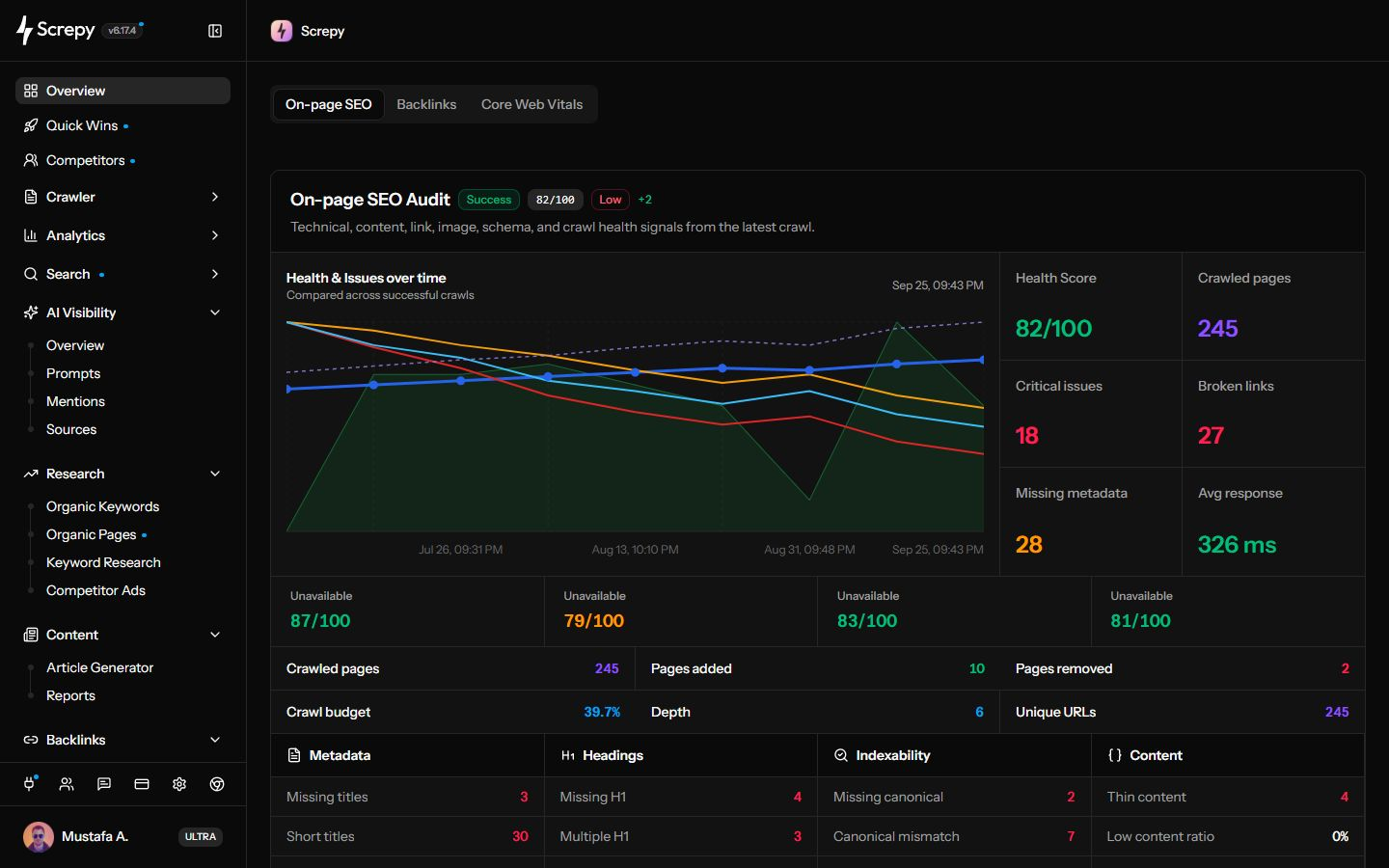










SaaS websites change faster than quarterly SEO reviews
Product launches, documentation migrations, template refactors, and campaign pages can alter organic acquisition between scheduled audits. Ongoing evidence makes regressions easier to isolate and assign.
Group affected URLs so engineering can fix the source pattern instead of patching every page separately.
Connect page, query, ranking, and audit context before deciding whether the next action belongs to growth, content, or engineering.
Protect organic acquisition after every release
Define the acquisition pages affected by a release, then review their crawlability, metadata, canonicals, links, performance, and availability. A dated comparison makes it easier to distinguish a release regression from an older issue.
Learn more about release monitoring- Identify the templates and routes changed by the deployment.
- Recheck priority pages instead of waiting for a broad traffic decline.
- Send engineering the exact URL, signal, and observed before-and-after condition.
Keep landing pages and documentation crawlable
Treat marketing pages and documentation as one discovery journey. Crawl their public URLs, review internal paths and response behavior, and investigate whether indexable signals match the role each page is intended to play.
Learn more about crawl and index status- Check product, use-case, integration, comparison, changelog, and guide pages.
- Trace broken links and redirects across marketing and documentation boundaries.
- Review Google index status separately from crawl discovery and directives.
Find regressions across shared templates
Group crawl findings by affected URL and recurring pattern. This helps engineering identify whether a page-level symptom comes from a shared layout, metadata helper, routing rule, rendering change, or content source.
Learn more about technical seo patterns- Compare product-led page types rather than treating every URL in isolation.
- Prioritize a template fix when one cause affects many acquisition pages.
- Recrawl after deployment to verify the observable condition changed.
Track category rankings and AI visibility
Monitor a deliberate set of category, feature, integration, and comparison searches, then review selected AI prompts for mentions, citations, sources, position, sentiment context, and competitor share of voice.
Learn more about search and ai visibility- Separate branded demand from category and use-case discovery.
- Review the ranking or cited URL, not only the summary metric.
- Treat sampled AI answers as variable observations rather than a complete market census.
A release-aware SaaS SEO workflow
Make SEO review part of the release lifecycle without requiring every engineer or marketer to become an SEO specialist.
-
Define the organic surface at risk
List the product, feature, use-case, integration, comparison, pricing, and documentation routes affected by the planned release.
-
Capture the pre-release state
Save current crawl, index, performance, uptime, ranking, and visibility evidence for the pages where a regression would matter.
-
Ship with clear ownership
Assign routing and rendering checks to engineering, page purpose and copy to growth or content, and measurement to the person responsible for acquisition.
-
Review the changed routes
Recheck the release scope promptly, then investigate only the signals that materially differ from the baseline.
-
Carry evidence into planning
Add unresolved regressions and newly observed opportunities to the next product, content, or growth cycle with exact URLs and conditions.
SaaS SEO use cases
Use Screpy where product delivery and organic acquisition meet, especially when many teams can change the same discovery journey.
Review the acquisition routes and shared components affected by a feature launch.
Check URLs, redirects, canonicals, internal paths, and index signals across the new documentation structure.
Sample and crawl the generated page type before template problems reach a larger URL set.
Connect the page to relevant product and documentation routes, then monitor its discoverability and performance.
Compare selected search rankings with prompt-level AI mentions and citations for the same product themes.
Connect queries and landing pages with the crawl and release context behind a SaaS visibility change.
Give growth, content, and engineering the same evidence
Screpy fits SaaS companies that want a shared operational layer for technical audits, search visibility, AI visibility, performance, uptime, and reporting. It complements product analytics and specialist enterprise research rather than replacing them.
- Growth teams can connect acquisition hypotheses to the pages and queries involved.
- Content teams can distinguish a content opportunity from a technical distribution problem.
- Engineering teams can receive exact URLs and observable regressions instead of vague SEO requests.
- API and SEO MCP access can bring stored Screpy context into approved internal workflows.
e1
example.comOwner
MKe2
example.orgMember
ALe3
example.netMember
JDSEO guides for SaaS companies
Continue with practical guides related to the website, search, and reporting workflows on this page.
SEO
Server-Side Rendering vs Client-Side Rendering for SEO
Compare server-side rendering vs client-side rendering for SEO, including crawlability, Core Web Vitals, caching, hybrid options and page-type release checks.
Read article SEO
What SEO Alerts Should You Monitor Before Traffic Drops
Choose SEO alerts for indexing, rankings and organic traffic. Set useful GA4 rules, verify site changes, and triage warnings with clear owners and evidence.
Read article SEO
How to Make JavaScript Websites Crawlable for Google
JavaScript SEO checklist for dependable indexing: pre-render key content, keep links and metadata crawlable, and confirm rendered HTML in Search Console.
Read article SEO
How AI Prioritizes Technical SEO Audit Findings
Learn how AI interprets crawl, search, and performance data to group technical SEO findings, estimate impact, and prioritize verification.
Read articleRelated SEO solutions
Explore the closest Screpy workflows for teams with overlapping responsibilities.
Build a technical baseline, choose realistic opportunities, and measure early organic growth.
Connect search evidence, content priorities, campaign QA, and stakeholder reporting.
SaaS SEO tools FAQ
Answers about release monitoring, documentation, technical regressions, rankings, AI visibility, and cross-team workflows.
Does Screpy replace product analytics?
No. Screpy focuses on public website health, search and AI visibility, performance, uptime, and SEO workflows. Product analytics remains necessary for in-app behavior, activation, retention, and revenue analysis.
Can engineers access Screpy data through an API or MCP?
Screpy provides authenticated REST API and SEO MCP access for supported project resources and workflows. Available endpoints, tools, permissions, and plan conditions should be confirmed in the current documentation.
What makes SaaS SEO different from a general website audit?
SaaS websites often connect product pages, use cases, integrations, comparisons, documentation, and frequent releases. The SEO workflow therefore needs both a technical baseline and ongoing review of the routes and templates that product and growth teams change.
How does Screpy help after a SaaS release?
Teams can compare crawls and monitor selected pages for performance and uptime, then review rankings, Search Console, or AI visibility where those signals are relevant. Screpy reports observations; the team still investigates whether the release caused them.
Can Screpy track SaaS category visibility in AI answers?
AI Visibility monitors selected prompts across supported platforms and markets, including brand and competitor mentions, citations, source domains, position, sentiment context, and share of voice. Results are sampled and can vary between runs.
Can Screpy monitor documentation and marketing pages together?
Screpy analyzes public website URLs within the project’s configured crawl scope. Teams can review links and technical signals across marketing and documentation routes when those pages are publicly reachable and included in the crawl.